
This next instalment contains book beginning with the letter “B”. Note that I have not included texts based on the fact that they are known as “The Book of Yah-de-yah-de-yah”; those works will be found under the first letter of their owner, point of origin, subject, or author (“E” for “Eibon”, for example).
That
being said, those looking for an entry for “The Black Book”, that is, Die
Unaussprechlichen Kulten under its well-known pseudonym, will have to wait
until we get the letter “U” (or check the earlier post on von Junzt which also
contains that information).
For
now, here are a range of books with “B” names and some associated material
deriving from them.
*****
The Black Book
of the Skull

“Beware of that
which lives under thy feet for one night it will rise up to take thee. For it
is known that beneath central Cakatomia, lurks great Othuyeg and his spawn.
Trapped for eons, they wait for when they can reclaim the land above their sunken
cities.”
-J’Cak Igguratian, Black Book of the Skull
The Black Book of the Skull is a grimoire
detailing its author’s experiments with summoning the Great Old Ones and serves
as an object lesson as to why human experimenters should shy away from dealings
with such entities. Written ages passed in the land of Quy (exactly where this may
be is still a question unresolved), the work devolves from a series of
well-defined experiments in hard metaphysics into a rambling diatribe, warning
against dabbling in such practices. Along the way it discusses Othuyeg and is
one of the very few sources of information regarding the entity Quyagen.
The
first edition of this work was written in Greek; however, all but one copy of
this edition were put to the flames by the Inquisition. The sole surviving copy
is in the library holdings of Dwayne
University in Amoston, Kansas, a donation from the family of a Holocaust
survivor who kept the book with him during his time in a Nazi prison camp. A
second edition was produced in France during the 13th Century: this
Latin translation was hindered by the fact that the translators chose to avoid
re-working the most blasphemous sections and decided to edit them out. A copy
of this iteration is kept at Miskatonic University. Finally, in 1915, Aleister
Crowley, down and out in New York and seeking work to finance his dubious
lifestyle, undertook a translation of the Latin version of the book for the Starry Wisdom Press: this edition is
hampered by Crowley’s insistence, as usual, on changing the material to suit
his own theories of magic and is a vastly inferior product.
(Source: “Invocation” & “The Seven Cities of Gold”
by Crispin Burnham)
Greek; J’Cak Igguratian; year unknown; 1d4/1d8 Sanity loss; Cthulhu
Mythos +6 percentiles; 29 weeks to study and comprehend
Spells: Contact Othuyeg; Banishment of Yde Etad; Call/Dismiss Azathoth; Call/Dismiss
Tulzscha; Chant of Thoth; Cloak of Fire; Dread Curse of Azathoth; Enchant
Brazier; Evil Eye; Parting Sands; Summon/Bind Byakhee; Warding the Eye
Latin; unknown translators; circa. 1250 AD; 1d2/1d6 Sanity loss; Cthulhu
Mythos +3 percentiles; 20 weeks to study and comprehend
Spells: Contact Othuyeg
English; Aleister Crowley, trans.; Starry Wisdom Press, 1915; 1/1d2
Sanity loss; Cthulhu Mythos +1 percentile; 10 weeks to study and
comprehend
Spells: None
*****
The Black
Litanies of Nug & Yeb

“[6] Have you not
considered how your Lord dealt with A'ad, [7] [The people of] Eruma (Irem),
possessors of lofty buildings, [8] The like of which were not created in the
[other] cities, [9] And [with] Thamud, who hewed out the rocks in the valley,
[10] And [with] Firon (Pharaoh), the lord of hosts, [11] Who committed
inordinacy in the cities, [12] So they made great mischief therein?, [13]
Therefore your Lord let down upon them a portion of the chastisement...”
The Qur'an, chapter 89 (Al-Fajr), verses
6 to 13
Nug
and Yeb are two lesser entities whose role is to eventually clear the Earth in
preparation for the return of the Great Old Ones. Two artefacts are mentioned
in relation to them: the Furnace of Yeb
and the Torch of Nug, to be used in
this eventuality. The rites of these entities, as practised in K’n-Yan, are
said to be especially abhorrent. While those of K’n-Yan equate them with
Shub-Niggurath, the monks of Leng claim that Nug and Yeb are actually avatars
of Zhar and Lloigornos and represent them with a modified Taoist yin-yang
symbol.

The
Black Litanies are rarely encountered
outside of the realm of K’n-Yan although it is reasonable to assume that there
are translations and copies on the Plateaus of Leng, Sung and Tsang. For a long
time, common knowledge had it that the only complete version of the Litany to Yeb was to be found on a wall
in many-columned Irem; until this location is found, this fragment of
information should be held as apocryphal.
(Source: “The Mound” by HPL & Zealia Bishop)
Arabic;
Author unknown; 700 AD; 1d6/2d8 Sanity loss; Cthulhu Mythos +10
percentiles; 30 weeks to study and comprehend
Spells: “Speak with Nug” (Contact Loigornos); “Speak with Yeb” (Contact Zhar); “Speak with the Black
Servitors” (Contact Tcho-tcho);
“Create Liao” (Plutonian Drug);
“Invoke the Power of Yeb’s Furnace” (Death
Spell); “Prepare the Feast of Wonders” (Food
of Life); “Nug’s Rebuke” (Shrivelling);
“Punish the Unbelievers” (Steal Life)
*****
The Black Rites
of Luveh-Keraphf

The
Black Rites are a chapter within the Scroll of Bast which is usually omitted
from most copies, being considered too sacred for general perusal. Written
during the Thirteenth Dynasty by the High Priest Luveh-Keraphf, the Black Rites have been handed down
secretly over the ages by a hidden sect devoted to the worship of the cat
goddess. The initial version of the ‘Rites
contain spells concerned with such Egyptian entities as Bast and Sebek, along
with Nyarlathotep in his avatar as the Black Pharaoh, among others; a later
Greek translation drops all spells pertinent to the Outer God but retains the
litany of warnings about interacting with Nyarlathotep in any of his
incarnations. This Greek translation is very hard to find – even moreso than
the Black Rites generally are – and
it is widely considered that the translation was illicit and made without
priestly sanction.
(Source: “The Suicide in the Study” by Robert Bloch)
Khemite dialect, Pharaonic text; Luveh-Keraphf; Thirteenth Egyptian
Dynasty (1786-1633 BC); 1d6/2d6 Sanity loss; Cthulhu Mythos +9
percentiles; 41 weeks to study and comprehend
Spells: “Call the Goddess of
Cats” (Contact Bast); “Command the
Goddess’ Servants” (Summon/Bind Cat);
“Bring Forth the Faceless Master of the Sands” (Contact Nyarlathotep’s faceless sphinx form); “Call the Black
Pharaoh” (Contact Nyarlathotep);
“Summon the Carrion Feasters of the Desert” (Contact
Ghoul); “Call Forth the Terrible Lord of the Riverbanks” (Contact Sebek); “Summon & Abjure
the Children of the Riverbanks” (Summon/Bind
Crocodile)
Greek; unknown translator; Ptolemaic Empire (305-30 BC); 1d6/1d8 Sanity
loss; Cthulhu Mythos +6 percentiles; 40 weeks to study and comprehend
Spells: “Call the Goddess of
Cats” (Contact Bast); “Command the
Goddess’ Servants” (Summon/Bind Cat);
“Summon the Carrion Feasters of the Desert” (Contact
Ghoul); “Call Forth the Terrible Lord of the Riverbanks” (Contact Sebek); “Summon & Abjure
the Children of the Riverbanks” (Summon/Bind
Crocodile)
The
Dutch version of the Black Rites was compiled by archaeologist Janwillen
Vanheuvelen during his time with the Clive
Expedition to Cairo in 1925. Since it was the text he used to teach himself
Egyptian Hieroglyphs, his rendering of the material is error-ridden and makes
several intuitive leaps that do not serve its translator well: he insists, for
instance, that references to the “crocodile god” concern the afterlife monster
Apep, rather than Sebek. Readers of this version are warned to tread carefully.
(Source: “Masks of
Nyarlathotep - Cairo” by Larry DiTillio & Lyn Willis)
Dutch; Janwillen Vanheuvelen, trans.; 1924; 1/1d4 Sanity loss; Cthulhu
Mythos +1d4 percentiles; 1 week to study and comprehend
Spells: “Call the Goddess of
Cats” (Contact Bast); “Command the
Goddess’ Servants” (Summon/Bind Cat);
“Summon & Abjure the Children of the Riverbanks” (Summon/Bind Crocodile)
*****
The Black
Rituals of Koth-Serapis
“The text is
rendered in Egyptian hieroglyphs. It is called The Black Rituals of Koth-Serapis. I doubt you have heard of it. It is little
known in the West. Even the learned Professor Wallis-Budge makes no mention of
it.”
The Black Rituals of Koth-Serapis is a collection of
rites which pre-date the Egyptian civilisation by several thousand years,
originating in the Stygian empire. It is apparent that the source of this work
came from a variety of sources and may well have been originally passed on as
an oral tradition before Egyptian scribes tortured enslaved adepts and collated
the material in this form. The work concerns itself primarily with the
cultivation and distillation of that pernicious vegetable, the Black Lotus.
“Ia!
Ia! Lloigor! Zhar fhtagn! Cfyak vulgtlm vultlagn!”
The
scroll begins with several prayers to Set (an avatar of Nyarlathotep, also
known as Typhon) then continues with discussions of Gol-goroth and its obscene
worship. Following this is an extended section devoted to the summoning and
worship of the Twin Blasphemies, Loigornos and Zhar. Thereafter, the text
extols the production and cultivation of the Black Lotus and the preparation of
many dangerous concoctions from this plant in the form of recipes. It is
theorised that the Tcho-tcho peoples stole this work and fled with it to the
Plateau of Sung in Burma where they subverted its religious practises to their
own despicable ends.
(Source: “Dope War of the Black
Tong” by Robert M. Price)
Egyptian
Hieroglyphs; Koth Serapis(?); Middle Pre-Dynastic Period (4,000-3,500 BC);
1d10/2d10 Sanity loss; Cthulhu Mythos +15 percentiles; 65 weeks to study
and comprehend
Spells: “Speak with the
Lotus God” (Contact Lloigornos);
“Speak with Set’s Dark Companion” (Contact
Gol-goroth); “Speak with Set” (Contact
Nyarlathotep, in his guise as Set); “Speak with the Bringer of Ecstasy” (Contact Zhar); Create Black Lotus Sleep Drug; Create
Black Lotus Poison; Create Black
Lotus Dream Drug; Create Black Lotus
Incense; Create Plutonian Drug;
“Call forth the Jackals of Set” (Summon/Bind
Typhonian Beast); “Bring forth the Ecstatic One!” (Summon/Bind Zhar)
*****
The Black
Sermons
“...the Itiqua, a peculiar Native
American tribe spoken of primarily in Joseph Durham’s The Black
Sermons...”
This
little-known work is the product of the diseased mind of Joseph Durham, founder
of the eponymous town in Ohio. It deals mainly with an extinct Native American
tribe – the Itiqua - and their worship of a “Great Sky Spirit” from the north.
It also details various theories concerning the origin of a circle of tall
black stones, 30’ in diameter, situated near the town in a forest known as St.
Elmo’s Wood.
(Source: “The Wind has Teeth” by G. Warlock Vance & Scott H.
Urban)
English;
Joseph Durham; Durham OH, nd.; 1d2/1d4 Sanity loss; Cthulhu Mythos +3
percentiles; 6 weeks to study and comprehend
Spells: “Summon the Great Northern Sky Spirit” (Call
Ithaqua)
*****
The Black
Sutras

“Before death was born, She was
born; and for untold ages there was life without death, life without birth,
life unchanging. But at last death came; birth came; life became mortal and
mutable, and thereafter fathers died, sons were born, and never was the son
exactly as the father; and the slime became the worm and the worm the serpent,
and the serpent became the yeti of the mountain forests and the yeti
became man. Of all living things only She escaped death, escaped birth.
But She could not escape change, for all living things must change as
the trees of the north must shed their leaves to live in winter and put them on
to live in the spring. And therefore She learned to devour the mortal
and mutable creatures, and from their seed to change Herself, and to be
as all mortal things as She willed, and to live forever without birth,
without death.”
-U Pao
Written by U Pao, one of Burma’s greatest scholars,
the ‘Sutras contain an extended discussion of the creation of life on
Earth and its subsequent development; this in no way emulates Darwin’s Theory
of Evolution but has a consistent internal logic of its own, touching upon
Mlandoth, Ngyr-Khorath, ‘Ymnar and Yidhra. It is notable for being the only
source concerning Yidhra which is unconnected to any process of gestalt
mind transference and unreferenced by any of the other standard Yidhran texts.
It is said to contain certain chants which are potent against Yidhran avatars
and its cult followers.
(Source: “Where Yidhra Walks” by Walter C. DeBill)
Burmese; U
Pao; c.700 AD; 1d4/1d8 Sanity loss; Cthulhu Mythos +5 percentiles; 18
weeks to study and comprehend
Spells: “Cutting the Web” (Close Minds); “Break the Touch of Evil” (Undo
Reversion)
*****
“Close Minds” (Mlandoth Rite)
This
spell requires the assistance of a second person: the caster weaves a cat’s
cradle around their fingers using a red thread while chanting an invocation to
Mlandoth and expending 5 Magic Points.
Once the ‘cradle has been completed, the assistant must cut the thread with a
pair of scissors or a small knife. The moment that the thread is cut, all
telepathic communication between Yidhra’s closest avatar and its followers,
human or otherwise, will completely stop for 60 minus 1d10 minutes; the effect
covers a mile in radius.
Once
completed, the caster then needs to make a Luck
Roll: if they fail, all of Yidhra’s
local followers as well as its avatar, become telepathically aware of the
location from where the spell was cast, once the spell’s effect wears off.
Sadly, the caster also knows that they know, and suffers a 1d4 point loss of
SAN...
*****
“Undo Reversion” (Mlandoth Rite)

This
spell requires the burning of several rare forms of incense found only in
Southern China, Indochina and Burma. The caster makes a set of ritual gestures
while performing a rigorous chant, making an invocation to Mlandoth. When cast
in the presence of an individual who has been permanently affected by the Reversion spell, it will undo the
effects of that magic. Note that this spell will also remove the effects of
lycanthropy and will purge a victim of the “Innsmouth Look”.
Due
to the loss of human sensibilities the victim instinctively tries to resist the
caster’s efforts and must be restrained. The victim and caster match CON and
expended Magic Points respectively on
the Resistance Table and the spell
has a base 5% chance of success. The process takes several hours and the caster
is left physically and mentally weakened, with a decrease in STR, CON and DEX
by 1d6 each and a reduction in all skills by 20% for 1d4 days.
If
the caster is successful, the victim must make a Luck Roll: if successful, the change back to their normal
physiology is permanent and lasting; if unsuccessful, the victim’s
reinstatement is only partially effective, and their APP is reduced by 3. Check
the following list for other side effects:
Restoration from Subhuman state: subtract 1d20% off
all the character’s restored INT and EDU based skills; SIZ is increased by 1.
Amnesia: the character needs to make an Idea
Roll to remember facts and skills
which pre-date their Reversion.
Restoration from Animal state: Lycanthropy – under
circumstances which reflect the initial Reversion,
the character undergoes infrequent temporary transformations into a Werewolf;
the character is more hirsute when in human form and is uncomfortable in
restrictive garb or overly enclosed spaces.
Restoration
from a Reptilian state: Ophidiophobia; the character dislikes
intense cold and is quick to succumb to hypothermia, falling into a catatonic
stupor in low temperature environments (<16°C / 60°F); the character is also plagued by
recurrent chronic psoriasis.
Restoration from an Amphibian state: The character
dislikes dry environments and becomes distinctly cold and clammy to the touch;
the character becomes plagued by nervous tics and strange compulsions to do
with water – obsessive cleaning, bathing, etc (-20% to Credit Rating).
Restoration from an Icthyoid state: The character has
developed the “Innsmouth Look” and will degenerate into a Deep One over the
course of their life from this point onwards.
Restoration from an Arthropod state: Entomophobia; the
victim experiences constant tinnitus which can require medication to control;
such characters become withdrawn and isolated, sometimes literally ‘cocooning’
themselves away; characters are plagued with recurring aphasia, a random inability
to produce or comprehend language while under stress.
*****
The Black Tome
(aka “The Black Tome of Alsophocus”)

This
work is abstruse and, thankfully, incredibly rare, although it is rumoured that
a copy of the Latin text exists in the Miskatonic University Library. The
original work was penned by a wizard of antiquity named Alsophocus of Erongill,
but any idea as to the language in which it was written has been lost in time.
A medieval monk translated it into Latin – somehow - in the late 13th
Century and it has been sighted rarely ever since.
The
material deals with – among the usual bestiary and herbal lore typical of the
period – the raising of Cthulhu from his dreams in R’lyeh and the nature and
manufacture of the Shining Trapezohedron.
Researchers are warned to approach this work with circumspection.
(Source: “The Black Tome of
Alsophocus” by HPL & Martin
Warnes)
Unknown language; Alsophocus of Erongill; Pre-human timeline; 1d8/2d8
Sanity loss; Cthulhu Mythos +13 percentiles; 60 weeks to study and
comprehend
Spells: Unknown
Latin; Unknown translator; circa. 1260; 1d6/2d6 Sanity loss; Cthulhu
Mythos +10 percentiles; 37 weeks to study and comprehend
Spells: “Speak with the
Sleeping God” (Contact Cthulhu);
“Summon the Wisdom of the Night-Flyer” (Contact
Nyarlathotep, as the “Haunter of the Dark”); “Awaken the Dreamer” (Summon Cthulhu)
Extractus
Alsophocus
During
the Renaissance, the Black Tome was
discovered by the Inquisition and a collection of extracts compiled from it.
This book contains no spells but is written in the Inquisitorial alphabet,
making decipherment a bothersome difficulty. The extracted passages are
concerned with the Shining Trapezohedron,
from its creation on Yuggoth to its disappearance during the reign of Nitocris.
It deals with the known qualities of the device and the means whereby it can be
used against the Haunter of the Dark.
(Source: Unseen Masters: “Coming of
Age” by Bruce Ballon,
et.al.,)
Latin, in the Inquisitorial cipher; Unknown translator; circa. 1517;
1d4/2d4 Sanity loss; Cthulhu Mythos +6 percentiles; 3d4 weeks to study
and comprehend
Spells: None
*****
The
Inquisitorial Alphabet

Most
people would not be too surprised to learn that the Inquisition, that
instrument of terror deployed by fanatical Popes throughout European history,
used a series of codes to hide the nature of the correspondence between their
agents. What is surprising is that this invented written language was based
largely on alchemical and Hebrew symbols. For an organisation heaven-bent on
wiping out heretics across the globe it seems more than a little hypocritical
of them to have borrowed their enemy’s alphabets as inspiration for their secret
codes. To add insult to injury, it’s also a very simple replacement code that’s
laborious to write, so what they gained from it is anybody’s guess.
Difficulty:
Slight: Idea Roll x2
Works
in this Language: Codex Maleficium (+20%); Zekerboni (+10%)
‘Rosetta
Stone’: None
*****
The Book of
Blackened Jade

Semi-literate, incoherent, pornographic, filled
with images of torture and perversion, The Book of Blackened Jade is a
product of the Tcho-tcho mind at its nadir. It is not a published work per
se but has cropped up as an obscure website, or underground ‘zine at
sporadic intervals, the earliest dating from around 1998. But for the fact that
the contents of each iteration build upon what has gone before, it could hardly
be called a discrete work; nevertheless it exists, and seems to be promulgated
through an active and anonymous organization. Chinese authorities are quick to
respond to the emergence of this material and it ranks very highly on their
lists of proscribed ‘literature’.
The bulk of the material revolves around the
seduction, rape, mutilation and murder of a young woman who describes the
process - along with her increasingly willing involvement in it - through a
rambling interior monologue, punctuated by rhapsodic poetry and – in some
online versions – blasts of heavily nihilistic and turgid rock music. Some
versions include a ‘high priest’ figure who orchestrates the desecration of the
victim and includes his thoughts in its narrative; other versions have two,
three, or even more tormentors and include their musings - or not - dependent
upon the literary capabilities of the author(s). In each case the depravity is
of a high order, inventive in its cruelty and very nasty in its perversity.
Several subversive presses in the West have been approached to publish this
work but so far none have made the commitment. Nevertheless, The Book of
Blackened Jade has achieved an underground cult status within many
alternative lifestyle organisations, including death metal music aficionados
and Southern-Californian Satanic cults of the Anton La Vey stamp. Many musical
artists have had their music co-opted into online versions of the material
(often without reference, permission or payment) and several of these bands
have, in response, created music in homage to the work. Amongst these are the
Norwegian fascist death metal group Oskorei; Mexican black metal band Nekrosis;
Japanese psychedelic pop group Sadistic Mika Band; Australian
death/thrash metal innovators, Armoured Angel; and – notoriously -
nihilist German group, Enthäutet, with their album, “Das Zischen von
ihr Risse”.
Hidden within the subtext of this work are snippets
of the Cthulhu Mythos: spells, devotional prayers, chants and so on,
interspersed with glimpses of Tcho-tcho history. In some incarnations the
material is so diluted within the indulgent phantasmagoria of death-fetishism
that it is all but worthless; in other instances, it is more potent. In recent
times copies have been translated into (often atrocious) English, or other
languages and these have begun to be traded on their own merits. Iterations are
invariably classified as “Valuable”, “Ordinary” or “Useless” by those who
pursue and collect copies. A burgeoning market of collectors has appeared in
recent years - holding clandestine swap-meets and conventions - and the values
of copies of the Book and associated memorabilia have begun to
skyrocket.
The following statistics can apply to either an
Internet website (with accompanying spoken content in a dialect or language of
the Keeper’s choice) or a low-circulation, printed magazine; in all cases,
hosting attribution or printing activity will reveal little or no overt
knowledge of the material and payment for such services will have been made
through cut-outs and other such secure methods.
Chinese; unknown author & date (circa 1998), “Valuable” edition; Sanity loss: 1d6/2d10; Cthulhu Mythos +12 percentiles; average 1 week to study and comprehend
Spells: Call Tcho-tcho; Contact Lloigornos/Zhar; Voorish Sign; any or
all of the T’ai p’ing T’ao
Chinese; unknown author & date (after 1998), “Ordinary” edition; Sanity loss: 1d2/1d6; Cthulhu Mythos +6 percentiles; average 5 days to study and comprehend
Spells: Call Tcho-tcho; Create Blue Glow; any or all of the T’ai p’ing T’ao
Chinese; unknown author & date (after 1998), “Useless” edition; Sanity loss: 0/1d2; Cthulhu Mythos +1 percentiles; average 1 hour to study and comprehend
Spells: None
English; unknown author, “Valuable” edition; 2001 onwards; Sanity loss: 1d3/1d10; Cthulhu Mythos +6 percentiles; average 1 week to study and comprehend
Spells: Call Tcho-tcho; Create Blue Glow; Voorish Sign; any or all of
the T’ai p’ing T’ao
English; unknown author, “Ordinary” edition; 2001 onwards; Sanity loss: 1/1d4; Cthulhu Mythos +3 percentiles; average 5 days to study and comprehend
Spells: Voorish Sign; any or all of the T’ai p’ing T’ao
English; unknown author, “Useless” edition; 2001
onwards; Sanity loss: 0/1d2; Cthulhu Mythos +0 percentiles; 4 hours to study and comprehend
Spells: None
Danish; unknown author, “Valuable” edition; 2001 onwards; Sanity loss: 1d3/1d10; Cthulhu Mythos +6 percentiles; average 6 days to study and comprehend
Spells: Contact Lloigornos/Zhar; Create Blue Glow; Voorish Sign; any or
all of the T’ai p’ing T’ao
Spanish; unknown author, “Ordinary” edition; 2001 onwards; Sanity loss: 1/1d4; Cthulhu Mythos +3 percentiles; average 3 days to study and comprehend
Spells: any or all of the T’ai p’ing T’ao
Japanese; unknown author, “Useless” edition; 2001
onwards; Sanity loss: 0/1; Cthulhu Mythos +0 percentiles; 1 hour to study and comprehend
Spells: None
*****
“Create Blue Glow”

Many
commentaries on Mythos magic refer to this as a “useless” spell, or one “of
little merit”; however, a hard metaphysician who has paid attention will report
otherwise.
The
spell consists of a droning chant and some hand gestures which must be actuated
at night while the moon is down. Casting the spell requires the spell-user to daub
ceremonial patterns on their face, neck and chest with the ichor of some
bioluminescent creature while chanting. The caster must expend a minimum of 1
Magic Point (MP) during these evocations, and this will ensure that the spell
will stay in effect for a period of about fifteen minutes. The spell summons a
trailing tentacle of bluish light which emerges from the chest of the caster
and slowly wends its way around the location wherein the caster stands. The
light will circle the caster, moving ever outwards until the time limit –
determined by the number of MPs spent - has been reached. At that time, it will
dissipate leaving a faint blue glow in the surrounding area which will fade
over the next twenty minutes or so. The caster loses 0/1 Sanity Point in the
aftermath.
For
this reason, many casters have described disgruntlement with the spell.
However, if the spell continues in effect for over an hour, any object made of
gold – or gold in its raw form as an ore - in the area will start to glow with
a sympathetic light. This includes any object which is hidden from sight, in
boxes or bags or hidden niches. Such hidden wealth will also be plainly visible
to the caster (and only the caster) who will see the glowing shapes
through the material which obscures them: it won’t tell them how to access the
gold, just where it is.
Many
magickal practitioners deride notions of wealth as a source of true power and
this may also be a reason why this spell is seemingly little-valued, but there
are differing points of view on the matter. For some, gold is a means to an
end, and being able to determine its presence, or not, can be quite beneficial.
*****
The T’ai
P’ing T’ao

This
is a collection of spells taught and demonstrated throughout China in the
various secret societies that abound there, especially the triad societies. The
manipulation of these groups by the Tcho-tcho has meant that actual Mythos
magic has taken root and has a measurable effect (if only by swelling the
belief in the power of the sect through rumour). This body of lore is called
the t’ai p’ing t’ao or ‘heavenly knowledge’ and was recorded in use up
until, and during, the Boxer Rebellion. Many of these spells have found
their way into common folklore, added into various Chinese grimoires and Mythos
texts from the region: Keepers may add some or all of them with impunity into
any Mythos tomes that their Investigators unearth while in China.
However,
the Tcho-tcho are known to jealously guard power in its various forms and do
not give up secrets lightly. Each of these spells has a mundane version which
boils down to a bunch of legerdemain, chemistry and psychology and which may
have been passed on instead of the true spell; as often, the spell faithfully
recorded into an older book of lore is completely fraudulent. Wherever one of
these spells is discovered, have the reader roll percentile die: a roll under
21% means that the spell is true and will work as described.
“Banner of Despair!” (Implant Fear)
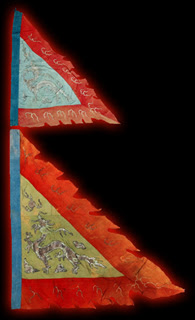
Magical
version:
This
spell imbues an image with the ability to cause terror in all those who look
upon it. In many battles with users of the t’ai p’ing t’ao, the main way
that this spell is used is to cast it upon a ‘charm banner’, a large, brightly
coloured flag covered with mystical emblems and carried before an advancing
force. All those who see the image must match their POW against the Magic
Points (MPs) spent in the creation of the image. The spell requires a minimum
of 5 MPs to be spent and costs 1d4 SAN points. The effect lasts until the next
sunrise or sunset.
Mundane
version:
In
this iteration, the image is one that is as horrible as the creator can make it
and its revelation is usually engineered in circumstances that allow the
creator to heighten the drama of seeing it. Sometimes it is heralded by a
collection of rumours promising evil to those who view the image; occasionally,
the unveiling of the image is accompanied by shrill screams or weird music.
Either way, this form of the spell works best against an opponent already
willing to believe in its negative effects.
“Body of Stone!” (Flesh Ward)
Magical
version:
The
Flesh Ward bestows points of Armour against non-magical attacks
upon the recipient of the spell. The caster prepares talismans of paper,
written with pear-wood pens, with sutras inscribed upon them. The recipients of
the spell begin a frenzied dance accompanied by chanting and are fed a potion
by the caster which facilitates the magic. With the expenditure of 4 SAN points
the caster bestows immunity to the tune of 1d6 points of Armour per 1
Magic Point expended.
Mundane
version:
The
potion in both versions is simply a distraction, often alcohol or a home-brewed
narcotic to deaden pain (oftentimes, opium). Once roused to an adrenalized
fever-pitch by the dancing and chanting, the recipients of the spell often
don’t even notice when they’ve been wounded anyway.
“The Closed Fire and Sand Curse”
“Disciples in the red dust, obstruct the
cannon’s mouths. Let their guns resound together and part the sands on both
sides of us.”
Magical
Version:
This
is another expression of the classic Boxer magic which renders the faithful
immune to foreign weaponry, specifically the ballistic kind. Like all versions
of this spell, the physical component is a piece of yellow paper, written over
with coloured ink displaying “true words”, which is carried somewhere on the
person. Most versions of this spell simply bestow extra points of Armour
upon the bearer allowing them to withstand a barrage for longer than normal;
this version acts a little differently.
The
Curse acts by repelling bullets away from the bearer of the parchment
talisman. When fired upon, the bearer rebounds the bullet, and the shooter must
make a Luck Roll or find that they have shot themselves. If they make
this roll, those nearby should then make similar rolls to avoid being hit by
the ricochet. In the case of artillery, the cannon’s Malfunction Roll should
be rolled with a +40% chance of failure, causing the gun to be destroyed by
returning shot.
To
cast the spell, the caster utters the “true words” while inscribing the charm
with a pen made from pear wood, all the while burning “gold paper” and incense:
the last lines of the chant are listed above. The spell requires the permanent
loss of 1 point of POW and a number of Magic Points equal to the number of
times that the charm will be effective (the sacrifice of POW is made first).
The caster suffers a loss of 1d6 points of SAN while the bearer of the charm loses
1d2 points of SAN the first time the charm operates. Obviously, in a heated gun
battle, the charm will lose its effectiveness very quickly...
Mundane
Version:
As
with other mundane versions of this spell, the casting ceremony involves much
trance-inducing chanting and dancing and the imbibing of a special “warriors’
potion”. This potion is simply a distraction, often alcohol or a home-brewed
narcotic to deaden pain. Once roused to a frenzy by the dancing and chanting, the
spell recipients often aren’t aware that they’ve been shot anyway.
“Fire of Heaven!” (Summon Fire Vampire)
Magical
Version:
This
spell is a modified version of the spell Summon Fire Vampire. The caster
creates a magical cloth, investing it with 1 point of their POW. The cloth
should be either yellow or red, and dyed, painted or embroidered with mystical
sigils and “true words”. Into one corner of the cloth, a small number of coins
should be sewn. The caster then awaits an evening when the star Fomalhaut is
above the horizon and casts the Summoning spell as per usual; however,
when the Fire Vampire appears, the caster brandishes the cloth and the ‘Vampire
becomes trapped, inert, within it, able to be safely stored away. At a moment
of the caster’s choosing, they are then able to flick open the cloth (using the
weight of the coins to facilitate this action) and release the Fire Vampire to
cause havoc. These cloths are especially useful for causing arson or attacking
enemies. Once freed, the Fire Vampire disappears back to whence it came; the
cloth may then be used in a repetition of the casting.
If
the coins used in creating the cloth are ones minted during the reign of the
Kiangsi Emperor (of the Ming Dynasty) then the Summoning spell has a
base 20% effectiveness.
Mundane
Version:
The
cloths in this version of the spell are not as elaborate. Usually, they are
knotted heavily in one corner, or have stones or other weights tied into them;
they are then dipped into some kind of accelerant liquid (petrol or oil, say)
and then ignited and tossed onto roofs, or through open windows. The Black
Lantern brigade of women Boxers are especially fond of this magic.
“Floating Soul”
Magical
Version:
This
spell requires the use of a copper bowl and water obtained from a high mountain
source, either from a spring or melted from a high-altitude snowcap. This
liquid must be used within a day of it being gathered otherwise the spell will
be ineffective. The caster creates an altar made with three pieces of wood, not
connected to each other by metal fasteners (such as nails, or wire), bonding
agents (such as glue or varnish), ropes, sinew or string, or wooden pieces that
have been worked by metal (wooden pins or dowels). The altar must be placed in
an open area where wind can move over it and sunshine and rain can fall upon
it. The copper bowl is placed upon this stand and is filled with the gathered
water.
To
cast the spell, the caster kneels before the altar and chants the “true words”
while burning incense and “joss paper” (paper strips with magic words written
on them). An offering of rice or orange peel is often made to whichever deity
of ancestor the caster feels to be the most pertinent. At the end of the
ceremony, they lose at least 12 Magic Points (by expending their full amount)
and 1d10 points of SAN. Their soul now separates itself from their body and
hovers over the copper bowl, appearing as a sort of heat haze to those who make
a Spot Hidden Roll in the vicinity.
The
caster is now immune to any damage which affects their body. Any attack which
causes them harm will be restored at rate of 1 Hit Point per minute until they
are fully recovered. An attack which disintegrates the corpus completely
will negate this effect, as will reduction of the body to zero Hit Points by
fire. If the body is pinned or held by the damaging effect – beneath a
landslide, for example, or held submerged beneath a body of water – the process
of regeneration will be halted until such time as the body is freed, whereupon
it will resume once more. The caster is not necessarily unaware of what is
happening to them during these restorations, and this may precipitate a SAN
check.
The
effect lasts only as long as the altar with its copper bowl of water remains in
situ; if anything happens to upset, spill or dismantle the arrangement, the
soul of the caster snaps back instantly to where it belongs, and the caster
will become immediately aware of what has taken place. This could well happen
at a very inconvenient moment...
Mundane
Version:
This
non-magical version of the spell has the same set-up as the supernatural
iteration, with one important difference: this spell is always cast upon
someone other than the caster. The target of the spell is made to believe
that afterwards, their soul has been separated and that they are immune to any
harm. The recipient of the charm is made to chant and fast, creating a
light-headed suggestible state; they are given euphoric, or opiate, decoctions
to drink and become unbalanced by the meaningless rituals. The bowl of water is
surreptitiously topped up at some point by a layer of clear oil which is then
set alight by means of a deftly-wielded joss stick: the heat haze that this
generates is usually enough to convince the target that their soul is now
floating on the sacred water...
“Flying Dagger”
Magical
Version:
By
means of this spell, the caster enacts a long-range attack upon a chosen foe,
attacking with surprise from an almost unlimited range. The spell is cast when
the caster writes “true words” upon a piece of paper, using a pen made from
pear wood, whilst burning “gold paper” (Hell money) and chanting, investing the
paper charm with half their Magic Points (round up). The caster must then
smuggle the charm into the clothing of their target, secreting it upon their
person so as not to be detected. Ideal places for hiding the charm are inside
hat bands, watch fobs, coat linings, tobacco pouches, snuff boxes, or similar:
regardless, the charm must be on the person of the target when the spell is put
into effect.
At
the desired moment, the caster picks up a dagger and strikes the empty air with
it, rolling their normal attack dice with a thrown, or wielded, knife; bonuses
for Martial Arts skills, or similar, are added to this roll, if
applicable. Wherever the target is – assuming that they are in the same
dimension as the caster – they are suddenly attacked by a
mysteriously-appearing dagger and, if the caster’s attack roll was successful,
they take normally-rolled damage (including Damage Bonus, if
applicable). They may also be susceptible to any poison which the blade may
have upon it. If the attack roll was unsuccessful, then the blade simply
materialises near the intended victim and clatters uselessly off the
surroundings, startling the target (and causing concern for their security) but
inflicting no physical harm. Meanwhile the caster loses 1d6 points of SAN.
For
attack purposes, this dagger is able to Impale – even if the target is
normally unaffected by such attacks - and is considered to be a magical weapon
for this one strike.
Mundane
Version:
This
form of the spell is the complete opposite of the magical version. Where the
magical version attempts to set up an ambush attack, the mundane version seeks
to make the target feel that they have narrowly escaped such an attack. The
caster needs to let the target know that they have the ability to cause a
long-range attack upon their enemy, and to subtly leak the information of the
process to them. They then should try to secret the charm – in this instance a
non-magical scrawl upon a piece of paper - upon the target’s person as outlined
above: even if the intended target fails to find the charm, they should be made
to feel as though they have been effectively targeted for a magical attack.
After
this, the caster then simply needs to find a way to sneak into the target’s
place of habitation and hide a dagger on the premises in such a way as to
surprise the victim by its discovery. If possible, the blade can be hidden in
such a way that the victim hurts themselves by lying down on it, or by walking
or sitting on it; or it can just be left in plain sight. The target must be
made to feel that they have narrowly escaped powers outside of their control
and, if the revelation is especially effectively staged, they might be liable
for a SAN check...
“Flying Fan”
Magical
Version:
This
spell requires the procurement of a well-made fan, either one well-made of
costly materials or a sturdy War Fan. The caster chants “true words” over it
whilst burning “gold paper” and costly incense for the duration. At the end of
the ceremony 2 points of the caster’s POW are invested permanently into the fan
and the caster loses 1d6 points of SAN.
This
item is especially effective if the wielder is versed in Martial Arts.
Whenever they need to make a Dodge roll while carrying the fan, they are
automatically carried to a point just outside of the zone of danger, appearing
to have executed a prodigious, floating leap. The same effect appears if the
wielder is a Martial Artist and chooses to try and Parry an incoming
attack – obviously, in this case, the correct rolls must be made in order for
this effect to be successful.
The
fan only works if it is carried by the caster and retains all of its original
Hit Points. Once it loses these, it is no longer of any use. Repairing the fan
between engagements will not prolong its life of usefulness.
Mundane
Version:
This
form of the spell requires a fair degree of initial set-up. The fan here is of
an especially tough construction and may not even be usable as a fan at all. In
fact, it is the handle of a secretive system of ropes, zip-lines and pulleys
which the caster has established at a point where combat is likely to occur.
Using these lines, the caster can engage with any enemies and appears to be
flying or making huge leaps during the fight. Of course, innate Martial Arts
ability goes a long way towards adding to the effectiveness of this illusion...
“Lance of Excellent Power!” (Enchant Lance)
Magical
version:
The
creation of this weapon requires the appropriate Craft skills for its
manufacture. Enchanting the lance costs 1 POW and 4 SAN points. When
finished, the lance does 1d10 points of damage and can Impale even those
creatures not susceptible to impaling damage.
Mundane
version:
Usually
just an old spear and a bunch of rhetoric are needed to convince the troops
that this spear is holy and super-effective. Obviously, if the spear -
decorated as it is with “gold paper”, tassels, sutras and whatnot – proves
less than miraculous, then the fault lies with the (former) user, not with the
instrument itself.
“The Never-Empty Pot”
Magical
Version:
This
spell requires the use of a sizable cooking vessel made of metal, like a
cauldron or large cooking pot. The caster sits before the vessel and chants
“true words” all the while feeding “joss paper” into a fire lit beneath the
empty pot. When the bottom of the pot begins to glow from the heat, the caster
stands and slices the palm of their hand with a knife: once the blood is
flowing, they must squeeze a piece of edible fungus in their wounded hand and
throw this into the pot. Immediately this is done, the fire must be
extinguished, and the pot removed from the cooking place. When the bloodied
fungus stops sizzling, the pot’s interior can be examined:
For
every 3 Magic Points expended by the caster in enacting the spell, 10 kilograms
(22lbs) of edible fungus will be discovered growing on the sides of the pot and
filling its interior. This can be cut out and prepared in many varied and
interesting ways, even eaten raw if needs be. There is a catch: timing is
everything with this spell and if the pot is too hot, or not removed quickly
enough from the fire, then it will not work. The caster needs to make a Luck
Roll to execute the manoeuvre swiftly enough for the spell to work. If the
spell fails the caster has suffered 1 Hit Point of damage and possibly ruined a
good pot; if it succeeds, they take the damage and lose 1d4 points of SAN. The
caster is able to call upon others to help in the ritual and these assistants
may add their own Magic Points to the spell; they do not lose Hit or Sanity
Points for their involvement, but an averaged Luck Roll of everyone
involved is used to determine whether the spell works.
Mundane
Version:
The female Blue Lantern brigades of the Boxer
Movement are masters of this spell effect, and it has a number of expressions
according to how hard the Devil is driving. The women of the Blue Lanterns are
well-versed in scrounging: infiltrating as they do the Foreign Concessions,
they are adept at stealing excess foodstuffs, spiriting away edibles that the
wasteful Foreigners disregard and eking out small supplies of rations. The best
Blue Lantern cadres are those whose averaged Bargain and Accounting skills are very high. In this way, they can make it seem that the food
supplies available to the Boxer forces are apparently limitless.
This effect is not simply a remarkable sense of
frugality, although that’s the biggest part of it. Given the devotion that
these women have for the cause, there are other procedures and skills which
they can bring to bear in order to feed and clothe the Righteous Fists of
Heaven. Opium is an appetite suppressant and judicious lacing of food and drink
with this substance can stop even the hungriest fighters from whining.
Ideologically, the Boxers see no problem with using the Foreigner’s “Black Mud”
against them in the war to drive them out of China. In certain dire cases, the
Blue Lanterns themselves eschew eating for a steady diet of opiates, leaving more
food available for the troops. And when things get really desperate, the Blue
Lantern ladies know how to render any kind of meat unrecognisable on a dinner
table. Any kind.

“Puppet Fighter”
Magical
Version:
This
spell imparts a Martial Artist’s fighting skill to another combatant, allowing
them to fight a single session of combat with skills to which they would not
otherwise have access. Under the supervision of the caster, the recipient of
the spell effect and the skilled Martial Artist are subjected to a period of
fasting and chanting, along with the ingestion of mind-altering drugs (often
opium, but alcohol will serve). When both individuals are in a suggestible
state, they are made to stand within a circle drawn upon the ground and the Martial
Artist is told to practise their skills while the subject is told to follow
their movements as closely as possible. The two are beaten severely with bamboo
canes if they refuse, or fail to perform adequately; all the while, the caster
shouts words outlining the conditions under which the spell will come into
effect: these should be simple but specific – “attack so-and-so when they come
for your evening report”, “attack the first person you see wearing a particular
medal”, etc.
The
spell has a base 10% chance of working; for every Magic Point the caster
expends upon it, another 10% is added to the chance of success. The spell takes
several days to orchestrate, and this should be roleplayed as much as is
possible. At the end of the casting, the Keeper rolls to see if the spell is
effective; the caster has no means of knowing if the spell was cast
successfully or not.
If
it is, the target of the spell uses the fighting ability of the Martial Artist
in a single combat session, the parameters of which are set by the caster’s
choosing. The subject will launch the assault and fight to the bitter end to
the best of the other victim’s ability. Until they see the end of the fight,
they will not recall the time and effort spent casting the spell; ironically,
they have no memory of these events even if the spell fails – until the trigger
event transpires, whereupon it all comes back in a rush, with a 1/1d6 potential
SAN loss sting in the tail.
Mundane
Version:
In
this form of the spell, the victim is imprisoned and denied food, sleep and
exposure to natural light. Once their resistance is sufficiently broken down
(accompanied by drugs and other procedures), a rigorous period of brainwashing
takes place. The victim and the caster compare POWs on the Resistance Table: if
the victim succeeds, the programming continues for another day. POWs can be
compared only once each day, so the time invested in this “magic” is fairly
intensive. Once the victim’s resistance has been overcome, the suggestion to
attack the spell-caster’s target can be implanted into their receptive mind.
Note
that, in this version of the spell, the victim fights using only such skills as
they already possess, and any equipment that they own, or are supplied with.
While executing the attack, they will believe that they have supernatural gifts,
but this is unlikely to be the case. Once the fight is over and the hypnotic
state evaporates, the victim may well be required to undergo a SAN check.
“Reawaken the Dead!” (Create Zombie)
Magical
version:
This
is like all other similarly named spells in that it creates an undead agent
from a dead body that will perform various limited directions as outlined by
the caster. It is dissimilar though, in the fact that it is cast upon the
living who, when killed, will then turn into the zombie warrior after death.
The
caster burns “gold paper” to invoke the will of the ancestors and to attract
the attentions of Heaven. Then, upon strips of paper, written with a pen of
pear wood, the caster inscribes a sutra to Yanluo Wang, the God of Hell,
asking him to allow the warrior bearing the paper charm the ability to avenge
his own death. Traditionally, this spell is cast upon those troops about to
enter battle. With the expenditure of 5 Magic Points and 2 SAN points per
individual affected, the charm will work as outlined.
At
the next moonrise, the bearer of the charm will arise after being killed,
reincarnated as a zombie, and will automatically resume the attack in which it
was engaged at the moment of death.
Mundane
version:
Under
cover of darkness, the caster and his associates enter the battlefield and
remove the dead bodies of the troops that have fallen. They then strip them of
their clothing and the bodies are burned, buried or sunk. The clothes are then
distributed among the next wave of troops with the imparted information that
the robes and armour are somehow ‘enchanted’. To the defenders the next day, it
appears that the corpses slain yesterday – with the rents and bloodstains still
upon them - have risen to do battle once more.
“Seize the Harvest!” (Bless/Blight Crops)
Magical
Version:
This
spell is most often used as a propagandist tool to turn the hatred of the
peasantry against a specific group (in China, usually foreigners). It costs 6
Magic Points to Blight one acre of vegetation, along with 1d6 SAN; the
same amount of Magic Points is needed to Bless a crop but there is no
commensurate SAN loss.
The
caster burns “joss paper” whilst walking around the field to be affected in the
darkness before moonrise. With the coming of dawn, the crop begins to be
affected as per the desire of the caster; this usually takes a day to complete.
If the caster loses any blood during the time in which the Blessing / Blight
takes hold, the spell is nullified.
Mundane
version:
Simply
stated, the caster and his associates, under the cover of the moonless dark,
traverse the field to be affected and do as much damage as they can, trying to
make it look like the ‘will of Heaven’. Rice fields can be drained, branches
broken, tubers uprooted and spoiled: much can be accomplished in this time.
Some variants have a recipe for a nasty herbicide which speeds things along
excellently.
“Soul Travelling”
Magical
Version:
In
this iteration of the spell, the caster sits facing into the sunset and stares
into the light of the setting sun until “their eyes glow with fire” all the
while chanting the protective “true words”. At the point when the sun
disappears over the horizon, the soul of the caster separates from their body
(along with 10 of their Magic Points and 1d4 SAN) and is free to fly invisibly
through the air and to spy upon the world around them. The Red Lantern troops of
the Boxer forces used this spell effectively to spy upon the Foreign
Concessions and to discover enemy troop movements and supply lines. The soul is
instantly returned to the host body at the next breaking of dawn; meanwhile,
the inert body is vulnerable to any attacks or accidents which may happen to it
and therefore the setting of a loyal guard is strongly suggested...
Mundane
Version:
This
version of the spell requires that the Red Lantern leader effectively
co-ordinates the resources represented by the Blue Lantern brigades, those
fifth column infiltrators who often work for the Foreign forces as servants and
drudges, picking up all the snippets of information that fall their way. The
caster may cobble together some mumbo-jumbo to impress their confederates with
their powers of insight, or they may simply suggest that they have access to
supernatural sources of information...
“Summon Demon Fog!”

“Traffic had been
brought a standstill some hours before; pedestrians there were none. King Fog
held the city of London in bondage. The silence was appalling. P.C. Ireland
felt as though he was enveloped in a wet blanket from head to feet...”
Sax Rohmer, The Trail of Fu Manchu
Magical
version:
This
spell requires a circle of devotees who chant and burn “gold paper” for the
period of the exercise. Each participant spends a minimum 5 Magic Points and
loses 1d4 SAN. The spell resembles Alter Weather but for the fact that
it calls down only one specific meteorological effect – damp, oppressive fog.
This fog lasts as many hours as Magic Points have been spent in its making and
covers an area of about 1,000 feet radius per participant: visibility is
reduced to practically naught. In the presence of those connected to the Summoning
of the fog (cultists, creatures and so on), unearthly tendrils of the vapour
visibly coil and probe, seeking to enter buildings, or thicken around light
sources.
Mundane
version:
Somewhat
similar effects can be obtained with smudge pots, various chemical compounds
and smoke. These are considerably more localised in effect and tend to be hot
and dry, rather than cold and wet.

*****

Various
Academic Papers:
ELIAS,
Jackson, (1921), “The
Black Power”, Prospero Press, New York, NY, USA
MARK,
Rafer R., (1987), “Behaviour
and Diet of pseudo-Rhinogradentia”, Dreamlands Studies 12:235-243
MUSTOLL,
Ivan, (1988), “The
Buopoth Proboscis”, Dreamlands Studies 13:140-167
STÜMKE,
Harald, (1964), “Bau
und Leden der Rhinogradentia”, Mutwillig Verlag, Hamburg, Germany


