Sunday, 7 February 2016

The Night Doctors - Part 1


This is a story which can go in several directions, depending upon how the Keeper wants it to unfold, or what kind of tale they wish to tell. On the one hand it can be a complete scübidüberism; on the other hand it can be a Mythos encounter; or it can be both.
Backstory
After the American Civil War, former slave keepers tried to prevent ex-slaves from drifting north by disseminating tales of predatory medical practitioners roaming the northern states and body-snatching African-American individuals, newly-arrived and looking for work. The idea was that, although now landowners could not own people to work their estates, they still needed to employ them to work their land. Having freed workers strike out to new territories meant that there was a potential drain on expertise and familiarity with local and regional work practises. On top of this, the Northern states sent labour scouts into the South to entice African-American workers away and, while southern landowners lobbied for restrictive laws to prevent such head-hunting, the drift away from the South continued.
Northern researchers into slavery conditions in the South, were confronted by white landowners’ insistence that their slaves were “stupid”, “sluggish” and “unmotivated”, requiring constant supervision by overseers in order to maintain quotas. These same researchers however, discovered that the slaves were intelligent, industrious and keen, but only on their own time, during the hours of darkness: it seemed the slaves reserved their best efforts for themselves and their own communities, while unobserved in their own settlements. Not that the slave-keepers were unaware that there were things going on after hours: the landowners disseminated wild rumours about ghosts and haunted locales, feeding into the superstitious natures of the slaves and which, backed up by Klansmen in white sheets riding night patrols (sometimes referred to as “patterollers”) effectively kept the black communities inside at night.
It might seem to be a bit of a stretch nowadays, to think that these tissues of flim-flammery would actually work, but it wasn’t all fairytales built upon nothing: Klan patrols regularly lynched slaves who were thought of as “uppity” and many recently-built medical institutions – particularly in the northern states – fell foul of rumours claiming that over-eager educators and students had taken to grave-robbing and body-snatching. There was enough smoke in the air over these incidents to indicate that offences had definitely taken place.
Some Southern landholders would dress up in sheets – attempting to appear as medical practitioners in scrubs – and stalk around African-American communities late at night, sometimes riding masked and roughshod through townships. Many of these appearances were services provided by Klansmen, so the white sheets were the simplest of disguises to affect. From this initial piece of theatricality, the superstition of the ex-slaves took over: the “Night Doctors”, as they became known, crept around the townships usually in pairs, assaulting lone walkers after hours, or breaking into unattended homes to steal sleeping children. The white sheets of the staged events, were soon replaced by the Ulster Coats that many field surgeons habitually wore and which were thought to hide and transport the bodies of suffocated infants. In some cases, the Night Doctors took on aspects of full-blown urban myth, with sharpened hook-fingers, poisonous breath, invisibility and the ability to call down death upon entire households.
Obviously, this was hysteria in full-swing. However, there were enough scandalous incidents taking place in America’s fledgling medical institutions to lend credence to the phenomenon and to have the desired effect that the southern landholders intended. In 1884, the Milwaukee Sentinel reported an incident in Ohio where medical instructors paid grave-robbers to provide specimens, which they did – a family of three freshly-murdered victims. In the same year, the Ohio Medical College hired a black cleaner for their institution who, when he saw some partially dissected bodies, panicked and fell down some stairs, breaking his neck: the matter was hushed up and the dead worker dissected; however, the facts eventually came to light. The Boston Herald ran a story in 1889 about a rumour amongst the black folk of Clarendon, Williamsburg and Sumter Counties that a white doctor with the power to turn invisible was anaesthetising the locals for medical experiments. A series of articles appeared in 1872, highlighting the tendency of black communities to go in fear of the Night Doctors, and these appeared as far afield as the Washington “Evening Star”, Ohio’s “Cleveland Morning Daily Herald”, Indiana’s “Indianapolis News” and the “Janesville Daily Gazette” of Wisconsin. As early as 1827, the black newspaper “Freedom’s Journal” was advertising cheap “mortsafes” - coffins designed to make a nocturnal disinterment long-winded and potentially dangerous for those embarked upon the procedure – a perfect gift for those frightened of post-mortem interference.
In Washington DC, the area which became the focus for the phenomenon, doctors serving the local community started to come under attack, if their work took them out among the black communities after hours. Mobs would appear to drive them away and several doctors were ruthlessly knifed and bashed. In one instance, the life of a black man – whom the doctors were trying to save – was forfeit due to such resistance. The phenomenon became so entrenched in the public consciousness that art began to imitate life, as anyone who has read Ambrose Bierce’s “One Summer Night” can attest.
Set Up
This story takes place in Baltimore, Maryland, around the year 1895. Many later Night Doctor stories were associated with Johns Hopkins University and its medical school, so the Keeper needs to create a reason why his party of Investigators would be here at this time (obviously, if their usual quests and obsessions have drawn them here, then that’s just a bonus!). As a few ideas, one or more members of the party could be returning here to receive their degree at an award ceremony, or have come back to receive accreditation in a new medical procedure (anaesthesiology is a good one). Perhaps, an old lecturer, or mentor, is retiring and there’s a farewell bash? Otherwise, libraries tend to be places where Investigators congregate, so perhaps there’s a volume of Lore which the party needs to examine here.
The Johns Hopkins Hospital is part of the Johns Hopkins School of Medicine, which itself is part of the Johns Hopkins University. The Hospital is specifically a teaching one, rotating students from the School of Medicine straight into the business of healing. The School is an imposing building with a grand dome and signifies the prestige with which the institution is regarded. When dealing with the authorities here, the Investigators should be made very aware that the School’s reputation is held as the highest priority in all matters.
A necessity for teaching institutions such as this one is the constant supply of cadavers for students to anatomise. Such bodies are taken from gallows, or from morgues, where the identity and relatives of the deceased cannot be verified. In fact, any person buried at County expense is fair game for the anatomists. Understandably, this causes some friction with the locals, and Johns Hopkins is looked upon with a wary eye by the lower classes.
And not without good reason. Medical institutions were not above advertising the fact that they were flagrantly exploiting the loopholes. The Medical College of South Carolina used this text in an advertisement of 1824:
“Some advantages of a peculiar character are connected with this institution, which it may be proper to point out. No place in the United States offers as great opportunities for the acquisition of anatomical knowledge. Subjects being obtained from the coloured population in sufficient numbers for every purpose, and proper dissection carried out without offending any individuals in the community.”
The word “individuals” here, meaning “white folk”.
Local law upholds that the bodies of blacks who die in the Hospital are the rightful property of the teaching establishment. In many cases, where the victim’s family is known and has showed concern for their stricken relative, the body is released to them after the patient’s demise; however, if quotas are not being met by the School, such concern is often waived. In essence, it’s bad luck to be sick or injured if you are poor and/or black; this is why folk medicines and supernatural healing alternatives were a burgeoning industry at this time.
Of course, along with witchcraft, grave-robbing was also on the rise. Those buried in “Potters’ Fields”, or in unguarded cemeteries, were fair game for bodysnatchers, and bodies - especially those who had died without the marks of violence upon them – earned a pretty penny from the stewards and other functionaries of the Hospital. Such trade was done without the direct knowledge of the respectable doctors, but their support of the crime was implicit.
Our Investigators should arrive at the Hospital during the Autumn or Winter months when – traditionally – supplies of cadavers were at their lowest and demand the highest. Those characters with medical backgrounds or other connexions to the University are able to be put up at their old college residence with the proviso that they put in some hours at the Hospital clinic, to pad out staff numbers during the semester. Keepers will establish some other form of accommodation for other members of the party and see them onto whatever purpose brings them thither. Rest assured that both groups will come together again before too long.
To Be Continued...

Saturday, 30 January 2016

Yian-Ho?

In October of last year video footage was taken of a mysterious city which appeared floating in the air over the settlements of Jiangmen and Foshan in the southern Chinese province of Guangdong. The grainy footage, which appears to show tall blocky buildings floating in the sky, was posted to YouTube on the 9th of October, accompanied by reports that hundreds, and later, thousands of witnesses had seen it. Only one of those onlookers apparently had the presence of mind to film the spectacle, since only the one piece of footage exists. Compared to the event in which an asteroid blazed across the sky in Russia the previous year and was filmed and photographed by many onlookers from many different angles and locations, this begs the question of whether or not this phenomenon is a hoax.

Apparently, the floating city was visible for only a few minutes and many locals who saw it declared that it was an instance of magic at work.


Objectively speaking, this appears to be an instance of the rare meteorological phenomenon known as the “Fata Morgana”. This is a mirage caused by temperature gradients where high strata of air are heated by the Sun while the layers beneath remain cool. The effect produces a visual distortion whereby distant objects along the horizon are refracted causing them to look as though they are closer and hovering in the air nearby. The term is Italian and is the name in that language for Morgan le Fay from Arthurian legend: Italian seamen passing through the Straits of Messina named the effect, believing it to be the work of a powerful witch trying to lure them onto the rocks with visions of fantastic cities and floating castles. The effect is also believed to be the source of legends giving rise to the “Flying Dutchman”.


Looking at it through a Mythos lens however, might this have been a materialisation of the hidden city of Yian-Ho, the headquarters of the Kuen Yuin and the worldwide Cthulhu Cult? Perhaps their cloaking magicks failed them on this occasion and they were seen opening their gates, either to admit or expel visitors? Or perhaps an intrepid group of Investigators found a way to enter their hallowed halls unannounced? Either way, we should probably be on the lookout for manifestations of the Xin - avatar of Ghatanathoa - or its loathsome satellites in the immediate vicinity...

Tuesday, 26 January 2016

Rip It & Run! The Onion...


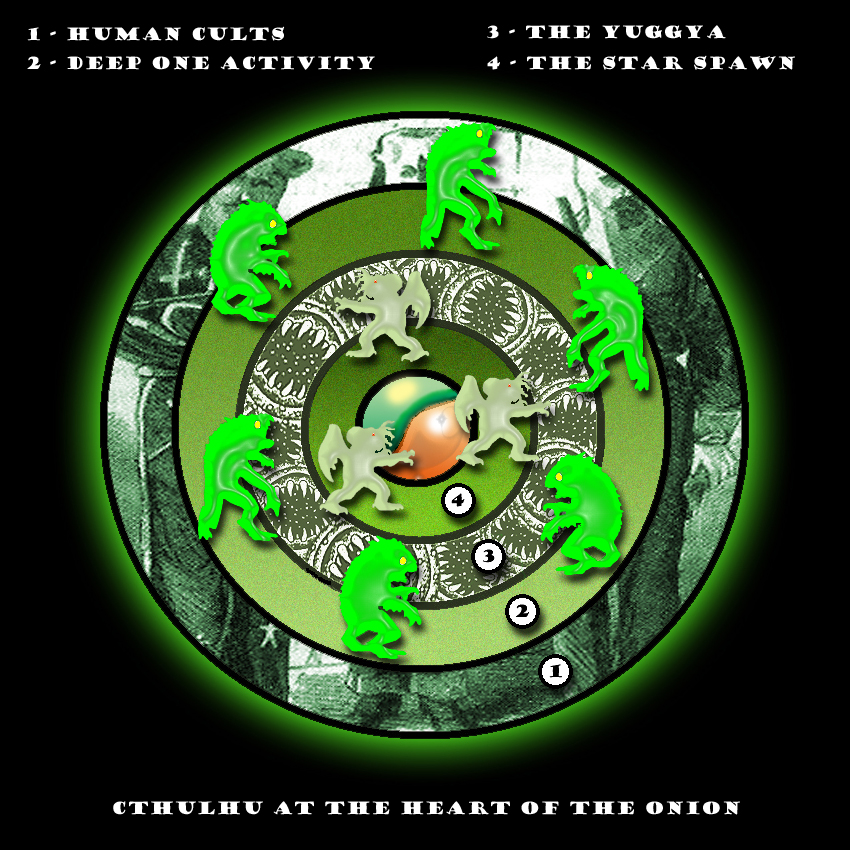
Writing a scenario – or a series of scenarios; that is, a campaign – for “Call of Cthulhu” might seem like a tortuous affair. However, if one keeps in mind a few simple guidelines, then it isn’t really as onerous as one might think. There are many approaches to take – and the Interwebz are full of other people’s views on the matter – but here is mine and I think it’s relatively straightforward and easy to use. It’s a process I call the Onion.

An investigation in this game can be likened to the slow peeling away of various layers of information and obfuscation, trying to penetrate to the heart of what’s going on. In essence, a “Call of Cthulhu” story is like the removal, one by one, of the layers of an onion until the heart of the vegetable is reached. Your players are here to unwrap the story you’ve brought to them; it’s easy then, to think of your plot as a gift that you have to wrap up. You simply have to start with the centre of the narrative and cover it up in layers.

First, you need to think of what’s going on, or rather, what is it that is causing something to take place. This is as simple as flipping through the rule book and looking at the Great Old Ones, or Outer/Elder Gods that there are to choose from. Think of this entity as the heart of the Onion: everything that is about to happen stems – intentionally or otherwise - from this source.

Since “Call of Cthulhu” is based upon a coherent Mythos, it’s easy to make significant connexions once you’ve decided upon the core of your menace. Say you’ve chosen Cthulhu as the Great Old One to feature in your story: there are many creatures and beings associated with Cthulhu that are all possible obstacles which your team of Investigators may well encounter in overcoming the threat which Cthulhu represents. Flipping through the various publications associated with the game, along with the many literary sources, you will see that there are Deep Ones, the Yuggya, Star Spawn, and a worldwide human cult that all work to promote Cthulhu’s insidious aims. These associated entities thus inform the progress of your adventure.

If Cthulhu is at the heart of the Onion, then closest to it would be the Star Spawn, being the next most insurmountable Greater Servitor Race; after these, one layer further out from the Star Spawn, would come the Yuggya; out from them come the Deep Ones – both these last creatures are Lesser Servitor Races associated with Cthulhu; further out from these are the human cultists of the Great Old One; and finally, we have the outwardly-unremarkable skin of the Onion. As you can already see, the further you penetrate into the heart of the Onion, the more dangerous it becomes.


Once this schema of increasing danger as the heart of the onion is neared has been determined, the Keeper can then start organising the locales across which their adventure will progress. As noted, Cthulhu cultists exist worldwide, so this makes roping the Investigators into the adventure relatively simple: it doesn’t matter where the party chooses to kick off. Cultists have fairly distinct goals which inform their activity: they seek ancient tomes or artefacts, strange ingredients for potent spells, victims for sacrificial purposes, or access to forbidden areas. Large cults need headquarters and funds, so many of them will have guarded buildings and connexions to either high finance or street level crime. Odd goings-on in these circles of activity will undoubtedly attract the attention of our heroes.

Soon, while pursuing the cult activity, the party will begin to encounter Mythos strangeness in the form of Half Deep Ones and then fully incarnated Deep Ones. Again, following the capabilities of these horrors, the locations for these encounters will push coastwards, moving the action to seaside towns, abandoned canneries, rum-runner hideouts, derelict oil rigs, and sunken vessels. After the first glimpses of these aquatic horrors, the Investigators will begin to revise their strategies to deal with things outside to the normal run of reality and turn to Mythos tomes for answers.

The Yuggya, or Yuggs if you prefer, are a step beyond the B-movie horror of the Deep Ones. They belong to deeply-hidden cults – connected to Ythogtha and Zoth-Ommog, offspring of Cthulhu - lurking behind the human ones connected to Cthulhu and, while they can manipulate human emotions and thoughts, they are wholly alien from the human psyche, or even the Deep One mentality. They are the first insight for the Investigators into the cosmic nature of the Mythos. The Yuggya are able to breed with half-human Deep Ones to produce strange offspring; they can burrow beneath the earth in all directions, and swim with great facility. In short, they can bridge the gap between the landward parts of the Keeper’s campaign and the final encounters.

The Star Spawn of Cthulhu rarely leave R’lyeh and so, logically, our series of adventures will no doubt tend towards this remote locale. Keep in mind that the events described in Johansen’s Journal are thought by some to reveal the capabilities of a single Star Spawn and not Cthulhu itself, so this should give you some idea of what encountering one of these beasties is like. Here, the adventurers have left normal reality behind and the full cosmic horror will start to reveal itself. After this, if everything goes pear-shaped, the Great Old One itself will appear!

Once this series of levels has been constructed, all the Keeper need do is firm up the locations between each layer; that is, build connexions between each of the layers so that the party can wend their way towards the conclusion. NPCs, incidents and locales will reveal themselves as the Keeper starts to create the links between the adventures; reading about the various creatures and gathering ideas for scenes and locations will generate set pieces and various other paraphernalia that can be brought into play. Boats and people to sail them; spear-guns, flare guns and tridents as parts of the party’s armoury; half-shark Deep Ones to explode expectations; spelunking equipment to explore Yugg tunnels: the more you let your imagination run along the bare bones of your narrative, the more surprises and connexions you will make.

Remember also that “Call of Cthulhu” is a game about books. Once you’ve pinned down your major Bad Guy (in this case Cthulhu), you automatically call into play a range of wicked tomes which specifically speak about it and its kind. These include, but are not limited to, the following: “An Investigation into the Myth Patterns of Latter-Day Primitives”; The Black Tome of Alsophocus; The Book of Dzyan; The Book of Eibon; The Codex Dagonensis; The Confessions of the Mad Monk Clithanus; The Cthaat Aquadingen; “Cthulhu Among the Victorians”; Cthulhu in the Necronomicon; Dwellers in the Depths; Invocations to Dagon; The Johansen Narrative; Legends of the Olden Runes; The Necronomicon; “Notes on Nessie”; The Ponape Scriptures; The R’lyeh (or Urilia) Text; Unaussprechlichen Kulten; and The Zanthu Tablets, to name but a few. Of course, any Mythos tome will reveal information about a specific Mythos entity with a successful Cthulhu Mythos roll, but these works have a special affinity with the Dreamer in R’lyeh. Now the Keeper can decide which Mythos tome(s) they want to use in their adventure and pin down what pertinent information and spells it contains that will drive the story forward.

This is a very rough method of writing the structure for a “Call of Cthulhu” campaign. It is very straightforward and will generate a series of adventures which will feel to some players like a traditional “Dungeons & Dragons” adventure; nevertheless, this is exactly how such Chaosium campaign series as “Shadows of Yog-Sothoth” and “Masks of Nyarlathotep” were constructed. Experienced Keepers will try to make their adventures feel like less of a ‘train-ride’ by factoring-in elements pertinent to their players and their characters, and by allowing bizarrely-successful (or dismal) dice rolls to turn the narrative in unexpected directions. No plan survives contact with the enemy, and an adventure outline is simply that – the Keeper’s best-laid plan.

This loose scheme of Mythos ‘dungeon-building’ works for any number of players and for any level of mayhem: by placing a relatively minor enemy at the heart of the Onion, and scaling back the connexions leading to it, the resulting campaign can be tailored for even a single player and still achieve a challenging and satisfying narrative. So the next time you are called upon to spontaneously generate an adventure at the last minute for your keen Investigators, give this method a try – I’m sure that you will find it useful.

Review: "Gotham - Season 1"


HELLER, Bruno (developer), “Gotham – Season One”, 2014-2015, DC Comics/Warner Bros./Primrose Hill Productions


In TV-land, especially on the supernatural fringes of that territory, Lovecraft and his creations seem to have become a touchstone for horror and fright-mongering. In recent productions, we’ve seen the Cthulhu Mythos take centre stage in an episode of “Supernatural” (wherein “The Haunter of the Dark” was sloppily executed); The King in Yellow become the nexus of a serial-killer’s madness in “True Detective”; and the Alhazred couplet (“That is not dead...”) used as a zombie–making spell in “Sleepy Hollow”. It seems that television writers have seen in Lovecraft’s work a veritable mine of material to plumb for their own ends and are falling all over themselves to throw in as many knowing references as they can.

It’s certainly no recent phenomenon. Way back in the 1980s “Cast A Deadly Spell” turned Fred Ward into a Chandler-esque movie version of Lovecraft in a world where magic was as common as potato chips, and the “Evil Dead” series of films made much out of the Necronomicon as the source of all, um, “deadites”. However, in the world of comics, the tradition is even older.

Arkham Asylum became a feature of the Batman landscape early on in the ‘80s when guys like Frank Miller were re-inventing Gotham City for the next generation of comics fans. By making Batman the “Dark Knight” the bat-landscape went from a brightly-coloured, high-camp playground for the spandex club, to a moody, corrupted, nightmare environment where psychoses and serial-killers stalked the streets and the only way to beat ‘em was to join ‘em. Of the many fantastic graphic novels which emerged during this renovation process, “Arkham Asylum” remains one of the touchstones for bat-fans everywhere: a more sinister comic was never unleashed upon an unsuspecting readership. Nowadays, perhaps the process has gone too far with the introduction of Gotham’s sister-city “Blüdhaven” – which we’re informed is even worse than Gotham – as a playground for Nightwing, but if nothing else it shows that there’s still life in the concept.

Obviously the works of HPL were an influence in this process and the name “Arkham” was lifted from there to underscore the insanity prevalent in the menacing world of Gotham City. In this way, I suspect that Lovecraft’s vision got a free boost as newcomers began to explore the roots of their four-colour reading matter. I’m not sure that Bob Kane – who was writing the first Batman and Robin tales while Lovecraft was building Arkham City – would have entirely approved, but time has shown that the tale of Bruce Wayne’s rise to become the protector of Gotham has lost none of its power to intrigue and to captivate.

Which brings us to this TV show. I approached this offering with some hesitation; I felt perhaps that too much blood had been drained from the carcase of the Bat and that this show would come off half-arsed and cheesy. The franchise has not been entirely free of misfires and false starts (“Batman and Robin”, anyone?) and shows like “Smallville”, “Arrow” and “The Flash” (the first one, not the current one, which I haven’t yet seen) haven’t really engendered much confidence in the small-screen treatment of the material. With characters like The Penguin, The Riddler and Catwoman front and centre, there’s a fine line between their portrayals working, or falling hopelessly flat. Anyone who saw the Catwoman movie with Halle Berry will know exactly what I mean.

It has come as a complete surprise to me therefore, how absolutely enjoyable this series is. DC, in its recent blockbuster manoeuvring around Marvel and the so-called “MCU”, seems to have all the creative energy of a flaccid balloon. Superman has launched and re-launched to no great effect; Aquaman seems poised to make a big-screen debut (seriously? Aquaman?) and “Suicide Squad” seems – to me at least – a poorly-considered misfire. I keep hearing that there’s a lot of excitement about “Batman vs. Superman”, but it feels forced and overwrought, as if they’ve let off all their fireworks in the afternoon. Less “wow!”; more “meh”. And yet Marvel are going from strength to strength. In the middle of all this lacklustre effort, it’s a pleasure to find that something is going right.

“Gotham” drops its focus from the cosmic events of Kal-el to the street-level dinginess of the city’s back alleys and its constant in-fighting of Mafiosi, all trying to topple Carmine Falcone from his perch as Godfather. The people are terrified; the cops are hopeless; the criminals and the elite live fat off their ill-gotten gains. Into this hell walks rookie detective James Gordon, keen to make his mark in memory of his father, a former Gotham City District Attorney. The scales are quickly torn from his eyes as he becomes gob-smacked by the blatant lawlessness and corruption, represented mainly by his new partner Harvey Bullock. Trailing in Bullock’s wake, we and Jim are introduced to the conniving and deadly nightclub owner ‘Fish’ Mooney, and her “umbrella boy” Oswald Kapelput (or Cobblepot, as he prefers) soon to become The Penguin. Shortly thereafter, the iconic shooting of Thomas and Martha Wayne takes place and we’re off to the races.

The brilliance of this show is in the casting. There’s not a single wrong note here. I was at first a little hesitant about Ben McKenzie as Gordon but he has enough range to cover all the bases that make a convincing future Police Commissioner of Gotham. Harvey Bullock, as played by Donal Logue, is a nice reintegration from Paul Dini’s award-winning “Dark Knight” cartoon series and plays fast and loose, dodging the flak from both the cops and the criminals. Ed Nygma (Cory Michael Smith), Gotham City Police Department’s forensic expert and soon to be The Riddler, is as crazy as you’d expect, but perfectly grounded in this environment. Others like Falcone (John Doman) and his opposite number Don Maroni (David Zayas), the nascent Catwoman (Camren Bicondova, who looks exactly like an animate Blythe Doll), Sean Pertwee as Alfred Pennyworth – there’s no-one here who doesn’t take their role and play it pitch perfectly. Even Bruce Wayne, boy-billionaire (David Mazouz), is great to watch: I was sure that he was going to be the weak link but he, too, belts it out of the park. But better than all of these are ‘Fish’ and The Penguin.

I expect Jada Pinkett-Smith read this character and just sank her teeth into the part. Her performance recalls Eartha Kitt’s Catwoman from the 1960s “Batman & Robin” TV show – all purr and deep menace – but she rages and spits as well. She plays for keeps in a relentless pursuit of power and it’s a sheer delight to watch. Fighting opposite her is the snitch with aspirations, Oswald ‘The Penguin’ Cobblepot (Robin Lord Taylor): dressed as a reject from some early noughties emo-band, his role is a high-wire act that could so easily have come crashing down in ruin. Spectacularly, it doesn’t, and every episode sees him clawing at another desperate inch of respect on his gruelling climb to power. Seriously, I’ve lost count of how many times he’s had the crap beat out of him, but it’s worth it just to watch him get his revenge.

Sadly, ‘Fish’ gets betrayed about halfway through the season, not by her associates (although that happens too), but by the show’s writers. After being chased out of Gotham she goes through a series of scenes on a remote island as part of a captured band of prisoners being culled for their organs. The sequence does little to reinforce or progress her character and signals the only bum note of the show. It feels like the writers didn’t know what to do with her after her fall from grace; surely they could have come up with something better than this?

One essential reason why this show works so well (apart from the material being iconic and tracking Bob Kane’s vision from origin through Frank Miller and Paul Dini to the latest blockbuster trilogy by Christopher Nolan, avoiding all of the missteps along the way) may not be immediately obvious to the uninitiated. Those in The Know will spot the name Ben Edlund popping up now and again: this guy is the creative genius behind the quintessential cartoon superhero romp “The Tick”: they say that satire cuts to the heart of that which it lampoons, so if anyone knows vigilantes, it’s Edlund. If you look really carefully, you’ll spot the odd headline reference to the Fledermaus, the cowardly Bat-clone from Tick’s The City.

To wend my way tortuously back to my first point about HPL and the Bat-scene, in this show there’s a corrupt (of course) city developer who goes by the name of Richard “Dick” Lovecraft, who shares a memorably-disturbing scene with a not-yet-completely-batshit-crazy Harvey Dent (Nicholas d’Agosto), in the episode entitled “Lovecraft”. Don’t get your hopes up however: Dick Lovecraft is just a corrupt slumlord who cops a bullet in the noggin and nothing more. There’s nothing Lovecraftian happening here apart from the name. Still, as yet another passing reference in an otherwise busy show, perhaps more fans will be brought over to the Mythos as we know it.

Four Tentacled Horrors from me.

Rip It & Run! Occult Investigators


One of the hardest things about constructing a “Call of Cthulhu” campaign is finding a rationale for having the Investigators band together in the first place. While it’s relatively easy to find an occupation for a new character, finding the “glue” that makes a team stick together is vastly more tricky. A handful of randomly-generated characters can be forced into a clump by the needs of a present story, but the moment any one of the characters says “What am I doing here?” the whole thing starts to fall apart. As well, while a single Investigation may satisfactorily occupy a group from beginning to end, moving on to a second story is sometimes a problem: will the police character be able to walk away from their day-to-day duties? Will the psychologist be able to clear their schedule for the next instalment? Will the reporter be able to use company resources to poke around once more? A skilled Keeper can usually overcome such obstacles, but players tend to flesh out their alter-egos with associative details that suddenly get in the way of just jumping on board the next tale.

Perhaps the reporter was just marking time on ‘Crime Beat’ and, now that they’ve proved themselves, they’ve won the Society Pages position they always coveted? Maybe the psychologist, at the end of the previous mayhem, declared that they were taking their reward money and heading for the Bahamas? And what if the cop’s injuries were so severe that he’s now riding a desk at the precinct in perpetuity? Again, a skilled Keeper might be able to circumvent these issues and “get the band back together”, but sometimes the progress that the characters make in one story preclude such easy reintegration. Of course, the Keeper may issue a “Star Trek”–like injunction at the beginning of play and insist that no character moves beyond their initial set-up rationale, despite anything that happens in the storylines; however, that seems somewhat artificial and reduces the levels of potential risk that the players face.

Paradoxically, for a roleplaying game, “Call of Cthulhu” asks the players to avoid getting into trouble at all costs. Implicit in the set-up is the notion that death and insanity (or both) are inevitable, so adventures are best skirted around. This means that, in this game, hooks have to hit hard and bite deep: the characters should have no choice but to engage with the drama, and the costs – if they opt out – should be commensurate. At the end of the day, the characters should want to get involved; or at least, should feel that any other option is completely out of the question.

Keepers learn – usually the hard way – that parties of Investigators will see a red flag and run in the opposite direction. The adventure, in most cases, has to come to the party, not the other way around. In one of my adventures, I had the body of a missing landlady stuffed inside a suitcase in the bare attic of an abandoned house. My team whilst investigating the building by breaking in, noted the suitcase and absolutely refused to go near it, fearing something dangerous or maddening inside, and so the object of their quest continued to remain a mystery. I should have just laid the landlady’s corpse out on the floor instead, or had it fall out onto them from behind a door. This was another instance of the players asking themselves “What am I doing here?”; their unwillingness to engage revealed that the answer was obviously not at all apparent to them.

To overcome these difficulties, it is often wise to establish a rationale for the Investigators from the outset, before character generation. “Delta Green” does this very efficiently, by making every character part of a sub rosa organisation bent on very specific outcomes. I once played in a campaign where all of the original characters were part of an ‘occult society’ based in Cambridge and whose half-arsed dabblings into Things Better Left Alone – a worm-can that was very, very difficult to re-seal after opening - led them onwards into ever more terrifying encounters. In short, a framework surrounding the group which provides a rationale for their actions is a very good thing.

A way to set up such a framework is to have one of the investigators take the role of an ‘occult investigator’ and have them rope in the other party members according to the skill-sets that they can bring to the investigation. There are many stereotypes for such a character in literature and film, but basically they should have high Credit Rating and Occult scores with a bunch of other research-based capabilities added on: think of them as a cross between the Antiquarian and a Parapsychologist. Alternatively, the character could be an NPC run by the Keeper, depending on how the Keeper’s players feel about such a responsibility.

By having a central character who actively seeks out paranormal situations and recruits other characters as needed, a structure is imposed upon the campaign narrative, forming a frame for all of the stories being told. There are some impressive precedents for such characters too: Stoker’s Abraham van Helsing; William Hope Hodgson’s Dr. Carnacki; Sheridan le Fanu’s Dr. Heselius; Algernon Blackwood’s Dr. John Silence; and that’s before we get to non-literary guys like Karl Kolchak and Fox Mulder. A central character whose raison d’être is to investigate The Unknown automatically focuses the scope and aims of the investigation, moreso than a motley group of disparate individuals who are brought together by happenstance.

Perhaps all the characters are related, whether they know it or not, to members of a secret organisation who oppose mystical enemies of humankind and the new leader of the group (our central character) has to contact them to reveal their destinies by handing over the sacred flame? Will they rise to the occasion, or walk away from a familial duty (with devastating consequences)? Perhaps our central character received a vision identifying the various party members as somehow crucial to his destined purpose? Once the rationale is explained, everything pretty much falls into place.

Another bonus to this set-up is that the players can create several characters each, covered by the same pretext, and thus have ‘spares’ waiting in the wings should a horrible inevitability occur. Otherwise, as is natural for ongoing campaigns, NPCs and other bit players may be taken up by the players as main characters and integrated into the storyline.

The shorthand for these types of characters is that they keep the party on track, focused upon the demands of the investigations (even if - and especially if - such narratives are scübidüberisms), and prevent the minutiae of the characters’ existences from derailing or blurring the lines of the story.

I’ve mentioned this process before – it’s called “establishment” and it’s crucial for the ongoing success of a campaign. It’s like they say about tiled floors and men: lay them right the first time and you won’t have any worries afterwards...

Tuesday, 12 January 2016

Review: Tarra Khash: Hrossak!


LUMLEY, Brian, Tarra Khash: Hrossak! Tales of the Primal Land, Volume 2, Tor Books/Tom Doherty Associates LLC, New York, NY, USA, 2006.

Octavo; hardcover, with metallic red spine-titling; 256pp. Near fine in like dustwrapper.


In his novella “The House of Cthulhu”, Brian Lumley established the prehistoric continent of Theem’hdra as an early locale for all things Mythos-related. Existing prior to the age of the dinosaurs, the continent was the home for various powerful wizards, among them Mylakhrion, Exior K’mool and Teh Atht. The landmass was home to myriad environments from rainforested southern isles to sere deserts. Centrally located was a gigantic inland sea which was home to an even earlier species of sentient humanoid than the Theem’hdran humans, the Suhm-yi. While this locale has featured in many of Lumley’s Mythos works, this is a focussed series of linked narratives, which follow the endeavours of one Tarra Khash, adventurer from the steppes of Hrossa in the continent’s southeast.

Lovecraft’s Dreamlands stories cemented the notion that the Dreamlands of Earth were a realm of the fantastic, a literal fantasy world wherein anything might happen. The tone of his Dreamlands tales is reminiscent of most fantasy genre material which appears these days – low-tech environs of a medieval or Renaissance flavour. It’s anyone’s guess, I would hazard, whether Robert E. Howard influenced HPL in the writing of these tales or vice versa, but REH’s ‘swords-and-sandals’ work links in strongly with this set of stories by Lumley. Clark Ashton Smith’s Averoigne narratives and the Lankhmar tales of Fritz Leiber are other touchstones for Lumley in writing this world and there are strong echoes of both running through the book. In short, it seems that, since the First Circle of Lovecraft writers frequently indulged in works of fantasy – probably what we’d think of as Dark Fantasy – Brian Lumley has decided to throw his hat into the same ring.

This is nothing like Gary Myers’s House of the Worm: there is no chilly cynicism running behind the nightmares. This reads like REH on Zoloft: The swords and biceps and loincloths are all here, but the sense of doom that pervades Howard’s work is absent. Too, there are flashes of Fafhrd and the Grey Mouser but without Leiber’s sly wit and dry humour. Cthulhu is mentioned a few times, but overall the horrors are kept mainly in the background and rarely burst forth to cause too much mayhem.

I suspect it stems from Lumley’s naval background, but he sets up obstacles in his stories – monsters; mystical menaces; lost and cursed temples – as things to be overcome, either by brains, or by brute force. His heroes scout the obstacles, formulate a strategy and – assuming that their plan survives contact with the enemy – win through in the end. As far as Mythos works are concerned, this runs completely contrary to the universe as Lovecraft saw it, but Lumley seems to have a lot of fun with it regardless.

The main thing that threw me about this book was the fact that, after a point about halfway through, Lumley decides to forego the use of articles, definite or otherwise. I suspect he did this to try and inject a sort of ‘olde worlde’ charm to the writing style (à la Gary Myers) but it only serves to be annoying, and somewhat confusing in places.

Tarra Khash is a likeable enough protagonist with whom to hitch a ride. He is nuggetty and clever, free with his cash, partial to a drink and sweet on the ladies. He wasn’t born yesterday and many of the evil cads he encounters in this book underestimate his cunning, to their cost. However, Conan he ain’t. Fafhrd he ain’t. There’s a kind of four-square blokiness about Tarra Khash that makes him seem slightly unreal: there’s no dark side; no grit; nothing compelling. What you see is what you get. When he wins through, you don’t feel like cheering; you just turn the page to see what’s next.

That’s not to say that these are boring stories – not in the least. The plotting is good and the pacing well timed. Tarra Khash’s opponents – be they scorpion gods, lamias, wizards, or thugs – are all well-sketched and worthy foes. There’s nothing hokey, or cheese-y, about the way the stories unfold and everything wraps up nicely, even unexpectedly in places. For my taste though, for a book with a stonking great picture of Cthulhu on the cover, it could be darker in tone - a little bit more edgy. This is definitely dark...lite?

Two-and-a-half Tentacled Horrors

Monday, 11 January 2016

Political Correction...


Recent discussions about the suitability of HPL’s bust serving as an award for a fantasy writing award in the US have impelled me to look once more at the writings of Lovecraft and see to what extent his racism affected his works. It’s true that there is a degree of automatically-assumed superiority in his writing, of the Briton generally, and of the white American over the United States immigrant, the settler of foreign stock; however, I have a sense that this strain is not any worse than that displayed by other writers of the period, and that, while it might well have been worse in his private correspondence, it was a relatively bland element of his published oeuvre. It’s true that HPL made several unfortunate comments about ‘foreign races’ in his letters and that he even championed some of the aims of the nascent powers growing in Europe during the 1930s; but many of these sentiments were abandoned in his later life, or even retracted. HPL lived an incredibly sheltered life, by the standards of any modern period, travelling little and gaining most of his experience vicariously, by reading the works of others. His time living in New York represents the one period when he left his cocoon and tried to gain first-hand knowledge of the modern world: it backfired upon him, forcing him to return to Providence, but the experience also paved the way for him to be able to undertake further journeys away from his nest, at least as much as his flagging fortunes allowed him.

It’s easy to perceive HPL as a rabid anomaly amongst the writers of his time, but that perception is flawed in the extreme. Other writers were as much or even more racist than Lovecraft and, it can be argued, their works have fallen by the wayside as a result of this blatant bigotry running up against changing social values. Any fan of Agatha Christie knows that her work is peppered with backhand references to Jews and that the presence of “people of colour” in her works is rare in the extreme. However, her touch in these matters is light and remains a major reason that her body of work continues to be published today. Other authors like Dorothy L. Sayers whose statements in the matter of race are less oblique, are certainly less popular nowadays. The general quality of Christie’s writing is the reason that she was able to write a novel entitled Ten Little Niggers and still have that book published well into the 1970s before the title was changed, first to Ten Little Indians and then to And Then There Were None. Along with Joseph Conrad she remains one of only two still-published authors who wrote books with that egregious word in the title.

Other authors, whose attitude to matters of race were less charitable (or at least, more obviously stated) have not survived to the current day, apart from low quantity reprints for a select market. The best example is “Sax” Rohmer and his Fu Manchu novels which, in their day, were best-sellers. His books are rife with derogatory caricatures of ‘foreigners’ and their stereotypical qualities, against which the stolid resistance of the British gentleman is the only safeguard. Another writer is John Masters – his best-remembered book is the Thuggee mystery, “The Deceivers” – whose works based in India at the end of the Raj, have long since ceased to have been put into production. His books are nowhere near as poisonous as Rohmer’s, but their raison d’être as part of the continuing colonial British Empire made them less than socially acceptable after Indian Independence. So too, Arthur Upfield’s series of Australian potboilers, focussing on the endeavours of half-Aboriginal detective Napoleon “Boney” Bonaparte, ceased being published in the 1970s – even after being filmed for television – due to a sense that the content was no longer politically acceptable.

It must be said that the books of these last two writers are nowhere near as politically incorrect as commentators would like us to think. Certainly, in the countries where they were based, they became an embarrassment and an obstacle against the emancipation of certain sectors of the community, and for that reason alone, they were justly removed from circulation. Upfield’s popularity – at least amongst the collectors’ market – is on the rise and Masters may well also enjoy such a resurgence. Nothing, however, will save Rohmer from being regarded as the tawdry and backward-looking symbol of a best-forgotten age.

In the case of HPL, I think that many detractors fail to look at his works in context. They cry “Racist!” upon hearing the fact that his favourite pet cat was called “Nigger-Man” and pore over his texts to find justification for their views. To my mind, their time would be better served by looking at the individual magazines in which his works were published and comparing the levels of toxic racism in those offerings vis-à-vis Lovecraft’s own relatively mild examples. Many of HPL’s contemporary contributors are forgotten today - many indeed were forgotten during their own lifetimes - but Lovecraft’s name lives on. Lovecraft’s work, in comparison to that with which it was published alongside, is notable for being less pejorative and of better quality in terms of writing and of ideas, than that of his peers.

In fact, speaking of writers who were published along with HPL, no greater example can be found than a writer who is considered one of the “Lovecraft Circle” and whose impact upon popular fiction is touted as the equal of Lovecraft’s own. That author is Robert E. Howard, whose creation, Conan the Barbarian, is said to be the fore-runner of all the ‘swords and sorcery’ fiction that proliferated in his wake. It seems strange to me that Lovecraft receives such vicious acrimony for describing a negligible, offhand character as a “low caste half-breed”, when Howard receives no such treatment despite offering paragraphs of racially-supremacist drivel in the midst of his phantasmagoria. It seems that four words from Lovecraft somehow more than counterbalance an entire manifesto from REH.

Is this fair? I think not.

There is a disjunction between the private life of the writer and the words that they choose to put into print. Some critics feel that the life of the author is fundamental to the understanding of their works; others feel that the work must speak for itself. Even skating a middle road between these two extremes, it would seem that HPL’s personal views about race are largely irrelevant to the points which he was trying to make. This must be so, or else we should all summarily disregard the body of work created by T.S. Eliot, whose private opinions concerning race and politics were vastly more poisonous than anything Lovecraft came up with. No human being is a perfect exemplar of the social ideals of the zeitgeist in which they emerged; if they were, then they would not be human.

It’s easy to place artists and their works upon pedestals; it’s just as easy to demonise them and cast them into obscurity. Either extreme however, implies a wilful blindness on the part of the judge, either to ignore good where it was present, or to turn a blind eye to base desires and crimes. Hemingway was a violent drunk and a womaniser; Twain kept a harem of barely-legal girls as “companions”; Yeats was a gullible junkie. Lovecraft, on the other hand, was a polite, self-effacing, kind and engaging semi-recluse, whose abiding failing seemed to be that he was a bit tight with his cash. And all of these writers wrote racially-regrettable statements, either in their private correspondence or their published works, simply because they were products of their time. Why is it that Lovecraft is vilified on this score more than these others?

The answer to that question must, inevitably, force us to look at those who make these observations – ourselves, as a society – and to own up to some hard truths. The short answer is that HPL was never one of the ‘cool kids’. Hemingway and Twain were gung-ho types; Yeats and Eliot were well-heeled socialites and Yeats had political motivations on his side. In reply, Lovecraft is a dorky-looking dweeb, out-gunned and out-manned by the opposition. The general populace was willing to let Hemingway act out as long as the terse prose kept on coming. Even the ultimate misanthrope, Ambrose Bierce, gets cut a huge amount of slack because he was a two-fisted fighter who was man enough to vanish mysteriously in the Spanish American War. Lovecraft, on the other hand, looks like a wimp; and wimps get sand kicked in their faces.


We live in a patriarchal society in which good-looking, and generally young, white men get to do whatever the hell they want; our society’s heroes conform to this model or at least toe the line, and those who flout this principle get barred from positive exposure. Kurt Cobain is an example of the latter effect: until his pointless death, no-one in power knew how to handle him; since then he’s become highly marketable. It’s easy to object to HPL’s head being used as a trophy for a fantasy writing award because he’s also dead and, as a bonus, his fans are all perceived to be emasculated geeks who are too disorganised to mount a coherent response. Fish in a barrel, folks; fish in a barrel. Personally, I think there are many more compelling reasons for changing this particular award to something that more adequately symbolises the genre, and none of them involve rummaging through the dirty linen of any particular author.

There are some who would see this as a win for racial equality and a blow to the patriarchy. Well, yes it is, but it’s a poor one and probably counter-productive in the long run. Surely there are bigger targets out there? Well, here’s one:


Robert Erwin Howard was a man’s man, good-looking by his day’s standards and burly, trained by working the land and sparring in the boxing ring. He was polite, learned and articulate; unlike HPL, he was able to make a living from his writing and unwilling to see it as a mere “gentleman’s pursuit” as Lovecraft did. He lived an orderly life with his parents and wooed the girl of his dreams (although, unsuccessfully). His failing was that he was depressive, too much under his mother’s influence, and he committed suicide shortly after she succumbed to a debilitating illness. It must be said that the bottom was falling out of the magazine writing business at the time of his death, but whether this was a factor in his decision to kill himself hasn’t been adequately ascertained.

Howard’s stories are all muscular tales of derring-do and two-fisted mayhem. He began writing fantastic stories of the Conan variety, but later turned his hand to material about which he had some first-hand knowledge: cowboys of the Wild West and sailors of the merchant marine. His style perfectly suited the pulp magazines with his hard-drinking, hard-bitten heroes and their wilting damsels in distress. If you think of Indiana Jones, you are thinking of one of REH’s heroes made flesh.

Compared to HPL, whose fans must desperately scrape together cash to make movies of his material, Howard’s works have spawned multi-million dollar, big screen productions, most of which are now reviled but which – at the time – were box-office successes. “Conan the Barbarian” has been made twice, “Kull” sprang from REH’s King Kull stories and even “Red Sonja” can be called a Howard vehicle. On top of these, hundreds of other swords and sandals flicks came out of the 1980s, more or less directly based on REH’s works. Even the character of Solomon Kane popped up in the most recent season of “Sleepy Hollow” (re-named to void copyright, obviously). Universal couldn’t even get HPL’s “At the Mountains of Madness” to the green light stage.

If Howards’s material could be summed up in a single descriptor, then “doom-laden” fits the bill. None of his heroes are happy-go-lucky types; they are all grimly determined, or prepared to die trying. Every time they win, it’s at some great personal cost. Even his funny stories are heavy on the cynicism. A frequent motif is the notion of ancient bloodlines emerging atavistically into the present: the number of times a protagonist gets hit on the head and experiences the manful strivings of a distant eon are too frequent to mention. And always the Anglo-Saxon, muscularly-bulging hero wins the day, even if they die in the attempt.

In Howard’s most directly Cthulhu Mythos based works, his loathing of the foreign is made overtly manifest. Most often he uses the horror of the re-awakened ancient aboriginal race – or its traits in a modern individual – as the focus of his story. In many of these tales, young educated men sit around and discuss theories of anthropology and the manifest superiority of the “Aryan race”. Given that most of these stories were in print in the early 1930s it’s scary to contemplate just how touch-and-go America’s siding with the Allied forces in World War Two actually was. I’m not saying that REH was a proselytizer for Adolf Hitler, but if he was thinking along these lines down in west Texas and magazines were blithely printing his cogitations, then the market must have been all over the notion and ready to read about it.

And of course, they were: eugenics was medical practice at this time; theories of racial segregation and hygiene held a lot of sway during the period. In fact, the Second World War was the crucible in which these theories were put to the test and where they ultimately failed to pass muster.

And yet, HPL gets tarred with the ‘racist brush’.

Hygiene – especially the racial sort – is a big focus of Howard’s Mythos stories. The heroes talk repeatedly about “cleaning the earth”, of returning to the “clean sea”, or of eradicating the unfit with “clean steel”. Discussions of genocide are stated matter-of-factly; other races denounced as “vermin”. And, unlike HPL where such matters are expressed as an aside if at all, these notions form the bulk and essence of the stories. The best example of this comes in “The Children of the Night”, one of many atavistic resurgences stemming from a blow to the head in REH’s oeuvre. It begins with a coterie of young men discussing anthropology:

“Clemants and Professor Kirowan had just engaged in a somewhat testy anthropological argument: Clemants upholding the theory of a separate, distinct Alpine race, while the professor maintained that this so-called race was merely a deviation from an original Aryan stock – possibly the result of an admixture between the southern or Mediterranean races and the Nordic people.”

So much for theory; the protagonist then puts the notions into a practical application, highlighting the fact that one of their number is found genetically wanting:

“And let me speak of Ketrick. Each of us was of the same breed – that is to say, a Briton or an American of British descent. By British, I include all natural inhabitants of the British Isles. We represented various strains of English and Celtic blood, but basically, these strains are the same after all. But Ketrick: to me the man always seemed strangely alien. It was in his eyes that this difference showed externally. They were a sort of amber, almost yellow, and slightly oblique. At times, when one looked at his face from certain angles, they seemed to slant like a Chinaman’s.”

One of the group then pronounces judgement on an absent acquaintance:

“Again Clemants shook his head. ‘When I was a boy working my way through a certain university, I had as a room-mate a lad as poor and ambitious as I. If I told you his name, it would startle you. Though he came of an old Scotch line of Galloway, he was obviously of a non-Aryan type.’”

The insidious Ketrick then contrives to hit our observer on the head, knocking him unconscious and back into an atavistic past. From this new perspective, as the Celtic “Aryara”, he discusses the various races with which he had interactions:

“The Picts were different from us in general appearance, being shorter of stature and dark of hair, eyes and skin, whereas we were tall and powerful, with yellow hair and light eyes. But they were cast in the same mould, for all of that. These Children of the Night seemed not human to us, with their deformed dwarfish bodies, yellow skin and hideous faces. Aye, they were reptiles...vermin.”

Returning to the present after some manful striving, our hero awakens in the study amongst his friends and realises that miscegenation of the pure race has perverted the one called Ketrick, and that there is only one cure for what ails him:

“...‘You fools, he is marked with the brand of the beast – the reptile – the vermin we exterminated centuries ago! I must crush him, stamp him out, rid the clean earth of his accursed pollution!’”

What follows are several pages of the protagonist’s musing about the nature of racial purity, what might have happened to muddy the gene pool, and what must be done to restore things to order:

“But let me speak of Ketrick. Ha – the short hairs at the back of my neck bristle at the very mention of his name. A reversion to type – but not to the type of some cleanly Chinaman or Mongol of recent times. The Danes drove his ancestors into the hills of Wales; and there, in what medieval century, and in what foul way did that cursed aboriginal taint creep into the clean Saxon blood of the Celtic line there to lie dormant so long? The Celtic Welsh never mated with the Children any more than the Picts did. But there must have been survivals – vermin lurking in those grim hills, that had outlasted their time and age. In Aryara’s day they were scarcely human. What must a thousand years of retrogression have done to the breed?

What foul shape stole into the Ketrick castle on some forgotten night, or rose out of the dusk to grip some woman of the line, straying in the hills?”

Thus, charged by these hateful notions of rape-fantasy, he takes a stroll out onto the moors where he knows Ketrick will be walking alone, in order to strangle him to death for the sake of the many, despite knowing that the pathetic notions of modern justice will doom him to the gallows. 

And yet – I ask again – Lovecraft is the racist?

This is one of the worst of REH’s atavism musings and the most poisonous of the lot. That’s not to say that such ideas are not embodied in all his works, or that there are some which can be read without encountering such material. No – they all partake of the same poison chalice in one form or another.

But what makes Lovecraft the target and not Howard? Some would say that genre fiction – fantasy, science fiction, historical romance – all owe a debt to Howard, so maybe it gets him a “Get out of Jail Free” card. The bald truth is that sword-and-sorcery stories play to the patriarchy – bulgingly muscular, phallic symbol brandishing, rape fantasies, meant to soothe the angst of pubescent readers. Men grunt and throb and sweat; women swoon and get ‘rescued’. In a competitively capitalist society, the readers are taught that fighting to succeed is good and will gain them the prize.

On the other hand, Lovecraft’s heroes are bookish nerds who discover that the universe is cosmically indifferent to their presence before they die. Or go mad. Or both.

On balance, who do you think is closer to the mark?