Friday, 5 August 2016

The Monkey Tree Puzzle - Part 2

Re-Group...

Having suffered this reversal, the party may wish to gather its forces and mark out some kind of plan of attack. As well it’s likely that some characters have been poisoned (or poisoned again) and must be cured before the party can continue its investigation.

Those interested in the matter of Colonel Mayberry and his headstone, can check details in the local church records, the register of births, deaths and marriages at the town hall, or in the archives at the local newspaper office; alternatively, they can talk to the sheriff about the situation.

It’s revealed that the Colonel met Dulcinea Estevez, daughter of a shipping magnate, while stationed in the Philippines. She was much younger than he and theirs was a typical “May-December” romance. The Colonel, who had resigned himself to bachelorhood, was completely besotted and showered his love with presents and attention. He built Pinecrest for her and she adored the place, throwing lavish parties and inviting friends to stay for long periods. Like her new husband, she delighted in the wilderness and they declared that their estate would remain a wild enclave; the only change that Dulcie made was the planting of a monkey puzzle tree – her favourite species and a reminder of the home where she grew up.

Sadly, tragedy struck. During a particularly harsh winter, Dulcie contracted pneumonia and it quickly escalated into pleurisy. Treatment arrived too late and she succumbed to the illness. The Colonel was inconsolable. He buried his love beneath her beloved tree and took to the solitary life of a recluse.

With this information to hand, the players may find themselves better equipped to tackle the situation.

Rainfall

The day after the encounter in the clearing, it rains heavily for almost 48 hours. This gives the players time to think about what lies before them and also to do research and deal with any damaged party members (or to call in some reinforcements if too many characters have been eliminated). The consensus might be that the rain will keep the dust from travelling too far afield, but upon reflection (and a Biology or Wilderness Survival roll) might realise that the material will probably wash downhill and into the river at the bottom of the hill, to do who-knows-what damage to animal and plant life downstream.

If nobody else thinks of it, the sheriff will travel up to Pinecrest and see how the Colonel is doing. He reports back that Mayberry is at home in his house and apparently unaffected by any spores. He says that the colonel hid within the canopy of the monkey puzzle tree and waited until the rain popped enough of the puffballs to form a break in the ring through which he clambered up the hill to his home. Of course, the party may wish to undertake this option themselves: Mayberry will report the above information while standing in his front doorway - he will not let the party inside his house, and Psychology Rolls will discern a strong disinclination for company, even moreso than usual.

If the party discusses their findings with the sheriff, especially the notion of the spores contaminating the water table and local waterways, he will immediately set about planning to build a bulwark along the river below the site of the infestation. To this end he will commandeer local earthmoving equipment and drivers (if this is a modern setting), or diggers, and lead this crew to the base of the hill, following the riverbanks from the main road. The party are more than welcome to join in this endeavour; while underway, they will notice the Colonel watching distantly through the windows of his home, but – unusually, it would seem - he never leaves to investigate the activity.

Hallucinatory Terrain

With characters poisoned by fungal spores and experiencing nightmares and other hallucinatory effects, it now behoves the Keeper to start bringing these visions into the real world. From this point onwards, as the players begin to deal with the threat in their midst, the powers of the fungus start to grow stronger and to target those who have already suffered from its effects.

This is a good opportunity for the Keeper to re-introduce old fears that the party may have experienced. Perhaps one of the party was stalked by a shadowy figure in an earlier adventure: now they catch glimpses of just such a stalker from the corner of their eyes. As things escalate, this bogey-man becomes seemingly more real until the character is convinced of its reality and forgets all about the fungal threat. Reintegrating elements from the party’s history is a good way to distract and disorientate them.

Alternatively, they may start to feel the effects of a bizarre physiological hallucination. Perhaps they hear a sound that they can’t pin down and no-one else seems to be aware of? Maybe they become fixated by the notion that some kind of fungal organism has burrowed beneath their skin and is roaming about their body laying eggs? Perhaps when they saw another party member putting on their gloves it seemed as though they were hiding the fact that their hand was in fact some kind of fleshy claw? The possibilities are literally endless but it will take some skill to sell these delusions to your players.

Remember to keep nightmares coming too. Waking up from what seemed to be a daytime situation gone horribly wrong can be jarring and unsettling, possibly worthy of a SAN Roll. (This also allows the Keeper to re-set the adventure if things go horribly wrong...)

A sensible party will bring all of this to a table and compare symptoms, constructing a strategy for dealing with it effectively (anti-psychotics; incarceration; therapy; what-have-you); but few parties are this organised. The Keeper should keep it in mind that the fungus is deliberately targeting those people it feels to be a threat, and it knows who they are if they’ve been infected by it in the past; keep the pressure on!

(As a side note, novels and movies like William Burroughs’ Naked Lunch, or David Cronenberg’s “Videodrome”, offer myriad different kinds of psychedelia as inspiration.)

Where To From Here?

With levels of paranoia peaking, it might be difficult for your team to get motivated; however, there are greater issues at hand than any one person’s personal bugbears. The sheriff is useful here for trying to keep the party on track, so keep him ready to prod your players along, at least until his messy demise...

There’s a notion that you’re not really paranoid if someone is actually out to get you, and when an imaginary stalker suddenly becomes objectively real, it’s a great sense of relief to the paranoid player. There is a shadowy figure lurking on the fringes of this tale and having it emerge while the hallucinations are raging is a neat way of introducing it.

The missile was a test strike against a remote human populace to examine its effectiveness. Having landed and deployed, its originators need to collate data to see if it works as expected. To this end there is an observer hanging around the test site, watching and recording.

Missile Researcher from Yuggoth
char.
value
char.
value
char.
value
STR
10
POW
13
Age
n/a
CON
11
DEX
14
HP

SIZ
11
APP
n/a
Magic Points
13
INT
13
EDU
n/a
SAN
n/a
Damage Bonus: None
Weapon: Nippers: 40% (1d6+grapple); Electric Gun: 40% (1d10+Resistance Roll to avoid heart failure; Mist Projector: 30% (20 shots: 1d10/round)
Armour: 8 points of Bio-Armour; all Impaling weapons do minimal possible damage
Skills: Conceal 60%; Hide 80%; Sneak 75%
Spells: None
SAN Loss: It costs 0/1d6 Sanity Points to see a Mi-Go

This entity is one of the Mi-Go. It creeps about Pinecrest estate initially, but as the effects of the spores start to spread, it increases its range to take in parts of the nearby human settlement. As the fungus begins to target the party specifically as a potential threat, the Mi-Go scout also starts to take an interest in them.

This lurker in the darkness has all the toys for which the Fungi from Yuggoth are known: bio-armour, weapons, whatever. Keep in mind that these creatures can fly and crawl up vertical surfaces and along ceilings; they are also telepathic, so they can really mess with your hallucinating characters’ heads. The scout is constructing an escape vehicle on the estate and needs to wait for this to be completed before launching back into space: it’s on a timetable, and will fight to ensure that its plans don’t go pear-shaped.

Oh, and remember all the Colonel’s dogs? They don’t work for the Colonel anymore – they have undergone a subtle change and they now work for the scout...


Fungal Hounds
char.
value
char.
value
char.
value
STR
7,7,6,6,6,5,5
POW
7,7,7,7,7,7,7
Age
n/a
CON
11,11,11,10,
10,10,10
DEX
13,13,13,13,
13,13,13
HP
8,8,8,8,8,
7,7
SIZ
5,5,5,5,5,4,4
APP
n/a
Magic Points
n/a
INT
n/a
EDU
n/a
SAN
n/a
Damage Bonus: -1d6
Weapon: Bite: 30% (1d6);
Armour: All Impaling weapons do minimal possible damage
Skills: Listen 75%; Scent Something Interesting 90%; Track 75%
Spells: None
SAN Loss: It costs 0/1d6 Sanity Points to see a Fungal Hound

The flesh of the dogs has been replaced by the action of the fungus. The alpha male of this pack was killed by the scout with its electric gun, which blew the dog’s head off; despite this, the dog has no problems carrying out its duties for its new master. All of these dogs are now made of a substance which more closely resembles the Mi-Go than a normal hound, wrapped around their original skeletons. In combat, these minions are unnerving (especially the headless one) but not especially effective; however, they are particularly useful to the scout for tracking down its enemies.

Once the scout and its sinister pack animals have been introduced, the worst thing that can happen is for one of your players to get all meta on you and say ‘Oh, it’s a Mi-Go. I know how to deal with these guys...’ As Keeper, you should keep your description of this horror as bizarre and unreal as possible, using all of your descriptive powers to throw off the party’s attempts to identify it absolutely. After all, fear of the unknown is one of the primal fears...

Meanwhile, Back At The Ranch...

The last we saw of the Colonel, he was ducking for cover beneath the monkey puzzle tree. After that we saw him regarding the sheriff’s digging activities from the lofty perspective provided by his rambling house. But what’s of most interest to us at this point is what he found underneath the monkey puzzler...

As we’ve seen, the fungus has a cunning way of invading the cells of living or dead animals and animating them by replacing their flesh with quasi-animal fungal matter. This stuff has grown beneath the monkey puzzle tree and coated the bones of the Colonel’s dead wife bringing it to a vague kind of half-life. Unfortunately, Dulcie Mayberry is too far gone to be any kind of living breathing entity, but the hallucinogenic effects of the fungus have worked upon the Colonel’s mind to fill in the blanks: as far as he’s concerned, she’s alive once more, just weakened by her exertions in coming back to life.

If any members of the party get a clear sight of her, they will see a horribly decayed skeleton packed full of toadstool-like growths and fuzzy mouldy adhesions. Most startling, her skull, with its empty eye sockets, is covered in a somewhat transparent slimy film which periodically bubbles up in cilia-like activity whenever it tries to scan its environment: these filamentous extrusions twitch, wriggle and pulse with various colours, in exactly the same manner that the head of a Mi-Go does when communicating. Any character who has had dealings with the Fungi from Yuggoth before, can make an Idea Roll to form this connexion, but only if the party has discovered a solid, logical rationale to implicate the Mi-Go.

In time, this creature will dispose of its skeletal frame and stand forth as a new Mi-Go; for now though, its movements are slight and its main form of defense is its ability to project hallucinogenic illusions to those around it. Characters encountering “Dulcie”, if they have previously been exposed to the spores of the missile, must make a Resistance Roll against the horror’s POW stat with their own POW. If they fail, they see a petite and beautiful (though somewhat pale and subdued) Spanish lady, well-dressed and polite, although tired. If they succeed with their roll, they see the fungus-clad corpse as it truly is, and feel the full weight of the monster’s animus.


Dulcinea Mayberry, as was
char.
value
char.
value
char.
value
STR
2
POW
17
Age
n/a
CON
6
DEX
2
HP
8
SIZ
9
APP
n/a
Magic Points
17
INT
13
EDU
n/a
SAN
n/a
Damage Bonus: 0
Weapon: Scratch: 10% (1d2); Grapple: 20% (special)
Armour: None
Skills: Call Telepathically for Help 75%
Spells: None
SAN Loss: It costs 1d2/1d8 Sanity Points to see Dulcie unshielded by her hallucinations

The Colonel is beside himself with joy. A miracle has occurred! His beloved has been restored to him through some strange power and his old life can resume once more! He has installed Dulcie in a small bedroom in the house where he can dote upon her, bringing her treats and her favourite baubles from the days before her sickness. He believes that she sees and hears him and that she speaks to him in response – this is all part of the psychedelic web in which he is enmeshed. He has become not unlike Norman Bates from Psycho, talking to a corpse which has become the centre of his world.

Having installed this horror in his house, Pinecrest has become Monster Central. The Fungal Hounds come and go as they please, monitoring the Colonel and relaying warnings telepathically to the Mi-Go; Mayberry sees them as normal dogs, when he notices them at all. Anyone observing the headless alpha male dog unscreened by illusions, will see an emerging cilia-covered ellipsoid growing from where its head used to be. As well, the Colonel believes that the Mi-Go scout is some kind of doctor sent to help his Dulcinea recover from her ordeal. In fact, the scout is concerned with the progress of its launch platform growing on the monkey puzzle tree outside and wants nothing to interfere with its getaway plans.

What’s Happening To The Tree?


Monkey puzzles have a very long lifespan. In their youth they look very much like standard pine trees – a vaguely conical shape with a pointed top. As they get older, they begin to “mast” – the trunk shoots upwards, uncovered by branches or greenery, and the foliage reduces to a wide platform of branches at the very top. If any party members decided to go back to the clearing and its single tree, they will see that a lot has been going on in their absence.

First, the monkey puzzle’s growth has massively accelerated and it has almost reached its maximum 60 metres (180 feet) in height. It is still an unearthly blue colour and the texture of the bark has become somewhat fleshy and moist, rather than being woody and hard. In fact, the top of the tree is now fairly level with the house on the hill behind it.

Characters will also note that the puffballs have reduced in number, concentrating at six equidistant points around the margin of the clearing. From the centre of each mushroom cluster, a single puffball has massively grown into a columnar shape, projecting upwards about 20 metres (60 feet) with a vaguely luminous, blue pulsating crown. Those who saw the “meteorite” land, several days earlier, can make Idea Rolls to realise that these are more missiles, like the one which started all this mayhem.

The Mi-Go spends much of its time at the slowly growing launch platform at the top of the tree, monitoring the progress of the fungal bloom and the growth of the ancillary weapons around it. The launch platform is almost complete and only a few more hours remain before take-off can occur. The nascent Mi-Go that has grown from Dulcie’s remains and the others forming inside the dog pack, will be abandoned as soon as the vehicle is ready, but they will inherit a world transformed by the missiles when they start to spread the fungal bloom across the planet.

In Conclusion...

At this point, everything is poised ready to come crashing down, either in favour of the Mi-Gos’ evil plans or to the gratification of our party of Investigators. Will the Mi-Go launch back into space? Or will it be brought down by our heroes? The party will have to gain access to the Colonel in order to oust the monstrosity which has corrupted his mind, and it’s highly likely that he will blow away the sheriff as they try and get inside his house. Of course, undead-mushroom-Dulcie might well gloat telepathically at anyone confronting her, revealing some of the insidious plan which is afoot.

The party needs to work out a plan to defeat the fungus. Those will Chemical or Biological nous might be able to commandeer a laboratory and create some industrial strength fungicide. Common fungicides are typically high in sulphur, at 0.5% concentrations for the more powerful liquid fungicides, while powdered forms tend to be 90% sulphur (and therefore very poisonous). Professional aviaries - for chickens or canary breeders and the like - often have stores of food-quality powdered sulphur to prevent fungal outbreaks amongst their birds. (Note that messing about with raw sulphur will turn silver black, requiring heavy polishing to reverse; so if your characters have a penchant for silver jewellery, are carrying photographic plates, or have magical accoutrements that might be affected, take this into account.) Naturally-occurring anti-fungal agents are oregano, rosemary, or jojoba oil, citronella, powdered kelp (often added to cattle feed) and milk. Failing this, good old-fashioned fire is a tried and trustworthy ally and a scorched earth policy might just be the way to go.

Critical to succeeding in this story, is the destruction of the ancillary missiles surrounding the monkey puzzle tree. If these are allowed to develop and launch, the incident will replay itself in six other locations across the globe, then 36 more locations after that, and so on. Of course, there won’t be any monkey puzzle trees in these subsequent events, but no doubt the spores will invade and mutate many other life-forms which they will encounter, twisting them towards their own insidious ends...


The Monkey Tree Puzzle - Part 1


This is a short scenario which can be dropped into pretty much any sort of campaign in any of the canon periods for “Call of Cthulhu” game play. It involves the deployment of a weapon by a Mythos race, in a first strike against the Earth and its denizens; to that end, it could lead to some serious repercussions in your players’ world, but only if they realise what it is and how to deal with it.

“Cthulhu Now” settings will generate a wealth of information about the weapon and how to deal with it. “Classic Cthulhu” players will have fewer options, and a “Gaslight” crowd fewer still; however, there are opportunities to win free of the menace in all three time periods. Given the entities behind this brutal attack (and it is deadly) a “Delta Green” team should be more than prepared to take this threat on.

For this game to work, the time of year that this story takes place must be during a time of frequent rain; it’s not necessary that it be raining constantly, but it should happen every other day or so. Establish the rainy nature of the weather with the party and then roll to see if it rains each day at a base 50% chance. Once you reach the section entitled “Rainfall”, you can let this feature slide.

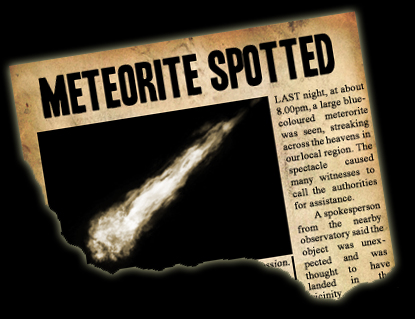
The story begins with the observation of a strange meteor which penetrates the Earth’s atmosphere and slams down into a local wilderness not far from where the Investigators are residing. If the party is outside at night they will see the object streak down out of the heavens trailing a luminous blue tail. Those making a successful Idea Roll will realise that the object is moving at a relatively relaxed pace, unlike a true meteorite. It strikes with a muffled boom like distant thunder.

If the party is inside when the object appears, have them make Luck Rolls to determine if they see the spectacle through a window. Otherwise, they must make Listen Rolls to see if they hear the muted boom of the impact, sounding like distant thunder on this otherwise clear night.

The missile (for that is what it is) has come down on private property in a pine plantation covering a hillside below a moderately-sized house owned by a retired military man. If none of the party’s rolls or actions allowed them to see the arrival of the missile, they will find out about it from the local news reports the next day.


Getting to the impact site is not as easy as one might imagine. The object has come down on private property – Pinecrest Estate - and the owner of that property is a reclusive type who does not welcome intruders. Colonel Eustace Mayberry (ret.) has been living alone in his hilltop estate since the death of his wife. He resents the appearance of the Press outside his gates looking for information about the “meteor” and makes no bones about his willingness to defend his privacy with the firearms and guard dogs which he has at his disposal. Disgruntled members of the Fourth Estate wander around the perimeters of his property and, in a “Cthulhu Now” setting, some media helicopters might buzz the pine forest trying to get some footage.

Gaining access to the impact site will involve some ingenuity on the part of the Investigators. Firstly, they must arm themselves with some rationale as to why it should be they – rather than any other team – who should have access; then, they should ensure that they have sided with the local authorities, the local sheriff’s office or some other agency of a similar nature. The Colonel is wary of people about whom he knows little and he gives “Government” a wide berth; he does admit to the usefulness of local individuals whom he has known for some time, so if the party cosies up to these figures, their way will be easier. Successful Credit Rating Rolls and military backgrounds will also make the team appear more acceptable to the Colonel. Keep in mind that the journalists on the Colonel’s doorstep will have tried a myriad different ways and angles to gain entry, so methods which rely on Fast Talk and Bargaining will carry little weight.


Sheriff Alfred “Al” Cunningham
char.
value
char.
value
char.
value
STR
14
POW
15
Age
42
CON
15
DEX
12
HP
14
SIZ
13
APP
12
Magic Points
15
INT
12
EDU
17
SAN
75
Damage Bonus: +1d4
Weapon: .32 Revolver: 70% (1d8); Fist/Punch: 65% (1d3+db); Grapple: 70% (special); Head Butt: 25% (1d4+db); Kick: 40% (1d6+db)
Armour: None
Skills: Bargain 55%; Drive Auto 85%; Law 80%; Persuade 75%; Spot Hidden 65%
Spells: None
SAN Loss: It costs no Sanity Points to see Sheriff Cunningham

The Colonel’s house sits atop a steep prominence surrounded by pine forest. (Use any handy map that you have to represent this house, even one from another published scenario. It should be at least two storeys tall and very elegant.) A well-constructed road connects the front gate with an elegant driveway before the building. To the west, the estate is bordered by a long valley at the base of which is a large stream that connects to a river in the north. The estate is not enclosed by fences except the property line which hugs the road from the nearest town. Some members of the Press have tried sneaking in before the party arrives and their encounters with dogs have forced them back onto public land.

If the party fails to gain permission to examine the impact site, they may have to resort to nefarious means of gaining access. This involves some serious hiking so Wilderness Survival, Navigation, Track and Sneak rolls will all be useful. Keep in mind that, if the party is unable to gain access before the next rainfall, there will be little for them to see if they do make it to the locale. If the attempts of the Investigators all come to naught, after the next rain, with nothing remaining to show that anything happened at all, the incident passes from view, becoming a nine-days’ wonder, soon forgotten.

The scene at the impact site leaves no crater, as would a normal ballistic missile; rather the pine forest on the western side of the hill seems to be covered in a blanket of blue dust. Against the dark green of the pine trees, the weird colour doesn’t stand out that much but it is noticeable, especially from a distance. Breezes in the area give rise to eddies and flurries of the dust, and the trees – both foliage and branches – are seemingly powder-coated with whatever this strange stuff is. The party can take samples of it or conduct experiments with it; however it will only remain in place until the next time it rains, whereupon it will wash away entirely. Of course, it simply moves from the surface into the soil below, but the party members may not realise this at first.

Investigating The “Dust”

However the party tests or examines the “dust”, they will soon discover that it appears to be some kind of fungal spore bloom. Successful Biology Rolls will determine this fact, while very good rolls will reveal that, while fungal, the spores are quite far from standard. Modern science regarding fungi places them at a mid-point between plants and animals: whilst conforming in many ways to the definition of plants, fungi exhibit animal traits on a chemical level as well, most noticeably from the amount of chitin in their cell walls. Modern Investigators will know this, and will be amazed by the sheer amount of this material in the specimens that they obtain; Investigators in earlier periods will simply be amazed at the fact of its presence.

Keepers should monitor how the party handles this substance. Ideally, breathing apparatus should be used whilst in its presence – even the simple precaution of a disposable paper mask, or bandanna. Gloves should be used when handling specimens and those who eschew this protection will notice that it stains their skin a bright blue colour. All characters who come into contact with the substance should make Luck and, if unsuccessful, Constitution Rolls (rolling under their CON stat on a d20). Those who make the first roll dodge the bullet and remain stain-free; those who fail the first roll and make the second have been poisoned and are in for some trouble; those who fail both are doomed.

Poisoned characters will develop bronchial congestion and other flu-like symptoms after 1d2 days. The blue stains on their skin will itch appallingly; they will begin to cough up a dark-blue phlegm and will complain of breathlessness. They will be wracked with fever and receive bizarre hallucinations and nightmares, coupled with a severe paranoia. Most will rave about a pervasive sense of imminent doom. On top of this, the patient will experience convulsions and spasms, vomiting and diarrhoea. Each character will take 1d8 points of damage: they will accrue one point of this damage per day until all the rolled points have been taken and the fever breaks. Keepers should keep the amount of damage for each character secret so that the players are not aware of the duration of their poisoning; also, until the poison runs its course, medical treatment won’t restore these missing hit points.

Those characters who fail their Constitution Roll will suffer the same series of debilitations; however, they take 1d4 points of damage initially, rather than 1d8. When these points have been accrued as damage, they then take 1d8 points of further damage. After the points from this roll have been lost, they then take 2d8 points. The number of d8’s worth of damage that they take increases by 1 thereafter until they are dead. The damage taken by these individuals is part of a systemic injury to the liver and kidneys – much the same as the amanitin poisoning inflicted by that fungus called the “Destroying Angel” – and it is irreversible and incurable. The Keeper may rule that poisoned characters must incur a SAN Loss of 0/1d10.

An autopsy performed on a character that dies due to this cause will determine certain oddities. Most noticeably, the lungs of the victim are congested with long trailing filaments of a bluish-white colour; when examined this substance will be recognised as tightly-coiled fungal threads known as mycelia. Secondly, and if the players are situated in a Classic Era or Modern setting, a blood toxin screen or an examination of their cells will reveal that all of the victim’s cells have been invaded by a fungal material which seems to prevent oxygen absorption and which affects mitochondrial function. There is a definite blue colour associated with this substance. For all intents and purposes, the person has been suffocated slowly from a cellular level upwards.

For each character who dies from this exposure, unaffected characters might suffer a 1/1d3 SAN Loss from a sense of helplessness and despair, according to the whims of the Keeper.

The Mountain Goes To Mohammed

After awhile, the fuss dies down regarding the “meteor” (during which time, if the party has other issues to forge ahead with, they can see to their usual interests). Then one day, the Colonel goes into town to see the local constabulary. A Luck Roll will allow characters to be in town and to see the Colonel at this time, while a very good roll will see them in the local police station on some matter.


Colonel Eustace Mayberry
char.
value
char.
value
char.
value
STR
13
POW
15
Age
56
CON
13
DEX
12
HP
14
SIZ
15
APP
10
Magic Points
15
INT
14
EDU
18
SAN
45
Damage Bonus: +1d4
Weapon: .30-06 Bolt-action Rifle: 60% (2d6+4); Fist/Punch: 50% (1d3+db); Grapple: 30% (special); Head Butt: 10% (1d4+db); Kick: 35% (1d6+db)
Armour: None
Skills: Accounting 75%; Electrical Repair 75%; Drive Auto 65%; History 70%; Law 60%; Mechanical Repair 45%; Navigate 85%; Revolver 55%; Wilderness Survival 65%
Spells: None
SAN Loss: It costs no Sanity Points to see Colonel Mayberry

Colonel Mayberry has come to town to report the presence of an intruder lurking around his house. He suspects that the reporters are back, sniffing out a story, and he wants the local police to do something about it. He claims that, whoever it is, they’ve been killing or capturing his dogs, because most of them have gone missing.

This is the moment that the party should stick in its oar and offer assistance. If they miss the opportunity, the Keeper should take the lead and push the issue. The local police authority will carry a lot of weight with Mayberry, but the players will still need to convince him that they are able to be of assistance. Again, Credit Rating Rolls and military experience will help.

Welcome To Pinecrest!

Having pleaded their case, the party receives an invite to visit the Mayberry home. However, Colonel Mayberry is not about to throw wide the doors and kill the fatted calf: when the players arrive, they will be met at the gate by the Colonel, his rifle and his two remaining dogs. He welcomes them onto the property, suggesting they bring what useful equipment they can carry, and leads them a short way along the main drive. Then, without warning, he turns off into the forest, urging the party to keep pace. If the group thought they were in for tea-and-biscuits and polite conversation, they have another think coming!


Mayberry leads the party west, around the hill upon which his house is built, and deep into the pine forest. As they begin to turn north, the trees start to thin out, and the bluff overhead upon which the house sits comes into view. If this is the first time that the team has had access to this locale, follow ahead with the description below; if this is a return trip for the party, things will be starkly different from their first visit.

Eventually, the party steps out into a wide clearing at the base of the western side of the hill. The ground here is covered with the crumbling trunks and branches of decaying pine trees. As they step through this carpet of rotting lumber, they can see that the remains of the trees are coated with a thick charcoal-coloured mould and wide, flat toadstool caps with greasy black skin are blossoming up from the earth below. Footing here is treacherous, not only because of all the deliquescing foliage, but also because all the rain has made the ground beneath very boggy. The clearing has a diameter of about 200 metres (600 feet) and the only feature visible within its compass is a blue-coloured tree with a complex canopy, about 7 metres tall, right in the middle of the space.

Characters returning here from a previous visit should be stunned. On their first trip, this area was completely forested with well-established pine-trees, albeit possibly covered with blue dust; now there is nothing here but dead and rotting wood, in a thick carpet roughly a metre deep, covering a soupy bog. The transformation is sudden and dramatic and should immediate alert the party to the fact that all is not what it seems.

The only thing in the area which is seemingly unaffected is the single tree in the middle of the clearing. Those with Botany or Biology skills can take a stab at identifying it; a successful roll will reveal it to be a member of the species Araucaria araucana, commonly known as a “Monkey Puzzle” tree. The species was first discovered in the 1780s and – after much haggling – was formally classified in 1873. It is a masting species of pine, indigenous to Chile, which can survive for up to 1,300 years. When young – as this specimen is here – it has abundant scaly foliage which shrouds the trunk; as it matures it grows very tall (averaging 40m or 130ft) and the foliage reduces until it forms a wide platform at the very summit of the tree. In the golden age of sailing, it was much sought after for making ships’ masts, but nowadays it is a threatened, and thus protected, species. A thing that the party members should immediately note is that this specimen is blue, and not the standard bottle green.

Some party members should become intrigued by the tree’s presence and aberrant features; however, any attempt to examine the plant will meet with steadfast opposition from Mayberry. If the sheriff is with the group, he may intervene on the party’s behalf and gain them some discreet access, but if not, Mayberry will absolutely resist the party’s attempts to investigate. He refuses to offer an explanation but seems bent upon guarding the tree from examination, even threatening violence if necessary.

Getting out into the clearing is very difficult in and of itself, given that the footing is treacherous in the extreme. Ropes and poles are the easiest solution, but even then, the attempt to cross the bog should be made with plenty of DEX rolls. The party is free to take samples and otherwise conduct an investigation of the site, but Mayberry keeps a watchful eye on anyone who approaches too near the tree. If a party member passes below the tree, down the slope from its position, have them make a Spot Hidden or Luck Roll: if successful, they notice a worked piece of stone amongst the rotting foliage and fungus. This is a marker stone bearing a bronze plate with the inscription “In memory of Dulcinea Mayberry. Taken too soon”. It’s apparent that the stone once stood at a higher point up the slope right by the tree, but that it has slipped down the hill.

If the party make too much of a fuss about this discovery, hauling it out of the morass or drawing Mayberry’s attention to it, he immediately becomes aggressive, arming his rifle and warning the party members not to mess with it. He starts trying to haul it about, attempting to free it from the mud and decaying matter and will not accept any assistance.

Psychology Rolls are appropriate here. Obviously the stone is some kind of memorial, and at one time was situated next to the monkey puzzle tree; successful rolls will discern that it is a grave marker of some kind and that the person it refers to was someone dear to the Colonel. It becomes apparent that the tree has been deliberately planted on somebody’s grave. As the Colonel is obviously not open to questioning, the party may choose to refer this matter to the sheriff or some other individual who may have more information concerning it. Town hall or church records may well contain details, even about an interment on private land, and the local newspaper may be a source of information too.

Suddenly: Puffballs!


It’s possible that not all the party members would be willing to risk a broken ankle by wandering out into the clearing; some may have chosen to wait on the sidelines in a support capacity. Have such individuals make Spot Hidden rolls: if successful, they will notice a ring of pale, football-sized orbs slowly growing up out of the decaying matter along the edge of the clearing. These are readily identifiable as some kind of white fungus, not unlike a puffball. Soon after they observe this emergence, they see one of them balloon up under a fallen branch and get popped by the weight of that limb. As the pale fungus collapses beneath the weight, a gasp of blue dust billows upwards and is carried away by the breeze. If the party has seen the effects of this stuff already, they’ll know to get out of range with all speed.

Obviously, the first priority is to recall all the party members and NPCs from the clearing. All those wandering in the bog need to get back to safety as soon as possible; Colonel Mayberry will be unwilling to abandon his gravestone and will insist on trying to haul it back to its former position. The players may have to make a hard choice about his survival. In the meantime, those party members not out in the swamp might try various means of trying to contain the dust: covering the puffballs with sodden blankets or tarpaulins – possibly the fabric of a tent – would probably capture most of the spores before they hit the air, but other methods may also occur to them. The puffballs are growing in a solid band all around the clearing, roughly a metre wide; where one of them pops, there are plenty more of them to fill the gap.

Once the party members have returned to the clearing’s edge, they will need to Jump over the puffballs or slip past them using DEX rolls, without bursting them; failing these rolls means that they have klutzed their attempt and the mushroom pops beneath them. Even if they succeed in their attempt, have them make a Luck Roll to ensure that a stray piece of their equipment hasn’t unfortunately poked or torn one of the puffballs. If the worst happens, have all those in the vicinity make Luck and CON Rolls to avoid contamination, as mentioned above.

Let the chips fall where they may. As the party re-convenes, have them note that the Colonel has abandoned his stone and is taking shelter from the dust within the coiling branches of the monkey puzzle tree. If anyone makes the observation that the emergence of the puffballs seemed like a calculated response to the party’s investigation, have them all make SAN rolls – 1/1d2.

To Be Continued...


Friday, 29 July 2016

Rip It & Run: Different Worlds...

One of the difficulties a Keeper faces when deciding to begin a “Call of Cthulhu” campaign, is where to set it. The game offers a range of canon time periods in which to set adventures and each of these has a number of playing possibilities. Modern-day technology and ease of investigation? 1920s joie-de-vivre? The formality and reserve of the late-Victorian era? The possibilities are endless.

Of course, a lot depends upon your players and which time period resonates best with them. Some might want to play in a milieu as far removed from their day-to-day life as possible; others might not be comfortable about re-enacting a time period which seems unreachably archaic. As Keeper, you often have to draw a line in the sand and say ‘this is it; this is what we’re doing’, which, while ending the argument, might put some of the players off side. Do you then just forge ahead and hope that the story will generate enough interest to offset a player’s resistance to the setting? Or is there a way to let everyone have their cake and eat it too? I’m here to say yes; yes there is.

Rather than narrow your focus to one of the canon time periods, take them all. Think of the offerings in terms of milieu as a broad canvas with no reason to restrict your activity to any one of them. There are a heap of advantages in taking this approach, so let’s look at how it can be done.

First: decide with your players where you are all going to start – Gaslight, 1920s, Modern day. Then, rather than telling them to make a single character for that time zone, ask them to make a family of characters which cover all three periods: thus, if you’re playing “Cthulhu Now”, ask the player to sketch out who their grandmother was in the 1920s, and who their great-grandfather was in the Gaslight era. Don’t let them get too carried away with fleshing these ancestors out: ongoing play will affect these characters’ standings and layer meaning onto them which won’t have been obvious during character generation. You’ll note that this takes care of the pesky ‘long-lost friend’ problem of hooking your characters into a scenario also.

As play proceeds, events which impact one of the three characters automatically have resonance with the other two. Does a scandal affect a character in the ‘20s? How does this impinge upon their modern day descendant? Does a Gaslight character stumble across a rare mystical tome? How – if at all – does their 1920s descendant get their hands on it? Once you get your players thinking across a three-stage setting, things start to have more meaning and nuance. For instance, if a Gaslight character dies without having spawned, this could mean that the modern-day character isn’t really their descendant after all, so, having blown apart a generally-held family fiction, how are they related? This is a game about mysteries, and families can be pretty damned mysterious sometimes...

Secondly, establishing your campaign like this, gives your story greater flexibility and range, while simultaneously removing the eternal problem of character longevity. The Keeper is free to have particular nemeses erupt out of the past and the source of these grudges might have roots in an earlier generation. ‘Damn!’ a 1920s character might expostulate, ‘these Azathoth flunkies again?! What did I do to harsh his vibe?’ Well, the answer to this question might lie in the Victorian goings-on of a forebear.

Now that all players have three characters to juggle, the group can flip-flop between settings, stretching out the danger and providing rests between the action that will make your campaign seem bigger, more multi-layered and wide–ranging, and – most importantly – longer in duration.

But that’s not all.

In the writings of the Lovecraft Circle, time switches and alters its flow according to the whim of the narrative, and there’s no reason why you can’t play like this either. Perhaps your Gaslight character plays a little fast-and-loose with their copy of the Pnakotic Manuscripts: what if they switch places with their descendant from the future? How will this fish out of water cope? How will their relative, bounced into the modern world, stack up? Will it drive them mad? With magic in the mix – even the cosmic apocalyptic type of magic that Lovecraft’s vision conjures – anything’s possible.

And let’s take another approach. Say that one of your players has the skill of Dreaming. A common issue with campaigns that stretch across to the Dreamlands, is that often only one player has the skill and, if the story calls for them to stumble about in Dreams looking for clues, the other players get to sit around twiddling their thumbs. Sure there are spells and magic items that throw the whole party into the Dreamlands, but why not allow the other characters who aren’t Dreamers, to roll up their own Dreamlands characters? These personae should all be predicated upon a connexion of some kind with the Dreaming character – that is, they should all know each other – in order to facilitate Dreamlands adventures, but the players should – as usual - have the option of playing whoever they please. An interesting exercise would be to let them try and generate a Dreamlands analogue of their Waking World persona, a move that allows the Keeper to switch the characters across the Veil of Sleep at some point later in the narrative.

But that’s still not all.

Lovecraft kept a rigorous diary of his more colourful dreams and these have sometimes made their way into his or other writers’ fiction. A good example is Frank Belknap Longs’ “Horror From the Hills”, which takes its starting point from a dream recorded by Lovecraft where he found himself as a Roman military commander in Spain. The Plutonian Drug, various spells or artefacts, even lucid dreaming or a heavy blow to the head (a la Robert E. Howard), can suddenly mean that you have a Cthulhu Invictus scenario running side-by-side with your regular setting. Alternatively, you can flash your players back to Dark Ages Cthulhu and have them traipsing across the landscape of Averoigne. Keep in mind, also, that time runs in both directions, so a futuristic Cthulhu setting could also be an option.

The trick of course, is to make sure that, wherever your campaign wanders, it has ramifications on the other settings and the characters within them. If a character in Ancient Rome hides a magic widget somewhere, make sure that the discovery of it has relevance to their ancestor down the track. You’ll soon discover that your players will start taking a “big picture” view of reality and will begin making choices that will affect their other characters in other milieu. And don’t forget that, as Keeper, you’re in charge of such beings as Nyarlathotep and Yog-Sothoth who both transcend the concepts of space and time, and for whom a setback to their plans in one reality can be a grudge offloaded in another...